Featured

Assignment Sequence Part 1

At long last, I’m going to share my Assignment Sequence. I’ve been holding back because I’ve been making changes and didn’t want to share unless I had it all figured out (ha!) But I’ve realized that’s never going to happen. So I’ll share my latest Assignment Sequence while letting you know I’ll probably change it again in the future (or maybe not, maybe I really do have it figured out this time : ). Anyway, some of my older posts (when I thought I’d have time to do a weekly update) include some details on these early assignments and exercises so feel free to look back at those. I’ll try to give enough information here so you can figure out what’s going on in my classes and replicate it in yours if you want to. You can also always reach out to me for clarification, more details, or any other reason. You can comment on the post or just email me at: steve.nelson38@yahoo.com. I’ll be at AWP in KC Feb 8-10 if you want to buy me a beer and pick my brain (or vice versa). Here is the information for the panel I’ll be part of:

Title: Beyond Composition: Creative Action in First-Year Writing Courses
Number: F204
Date/Time: 1:45pm – 3:00pm on Friday February 9, 2024
Location: Room 2215A, Kansas City Convention Center, Street Level

Okay, so this will cover the first 6 weeks of composition class (this is for a 15-week semester and a class that meets twice a week) (and this is the only composition class these studnets are required to take). First, I’ll provide the weekly calendar then below that details on the assignments and exercises (in the order they will be completed). For my grading, exercises are worth 10 points each and assignments (papers) are worth 100 points each.

FYC Class Calendar Weeks 1-6

Week 1:
T: Introduction to ENG 104, Exercise 1 (Introductory Letter) written in class
R: Exercise 2 (What is Good Writing?) completed in class,

Week 2:
T: Assignment 1 (Photo Essay) due, Exercise 3 written in class, Introduction to Assignment 2 and “Self-Reliance” (we read and discuss pargraph 1 and watch 1 or 2 videos to introduce students to Emerson and “Self-Reliance”)
R: Exercise 4 (quotations, paraphrases and thesis statements) completed in class, Exercise 5 (Sentence Outline) completed in class

Week 3: 
T: Exercise 6: (Discussion of Quotes from “Self-Reliance” + Planning Outline for Assignment 2) written in class (students needs to finish reading “Self-Reliance” before class meets and choose 2 quotes for class discussion)(arrange the chairs so students can all see each other for this class session if possible)
R: Exercise 7 completed in class (review and discussion of sample papers), Explain Exercise 8 (examples of “good” and “bad” writing)

Week 4:
T: Draft of Assignment 2 due for Peer Review (Exercise 9) (students bring 4 copies to class),
R: Exercise 10 (Show, don’t Tell) completed in class, Exercise 11 (Rhetorical Analysis) completed in class

Week 5:
T Assignment 2 due for grade, Exercise 12 completed in class (Academic Conversation on “Grit”), Present Assignment 3
R: Exercise 13: Introduction to Logical Fallacies

Week 6:
T: Draft of Assignment 3 (letter to Emerson) due (students bring 4 copies to class), Exercise 14 (peer review) completed in class
R: Individual Conferences: Check in and review Assignments 1, 2, and 3 (1 and 2 should be graded already). Depending on your schedule and the number of students, this may take up another class period in Week 7)            

So that is the plan, here are the assignment sheets and explanations for everything:

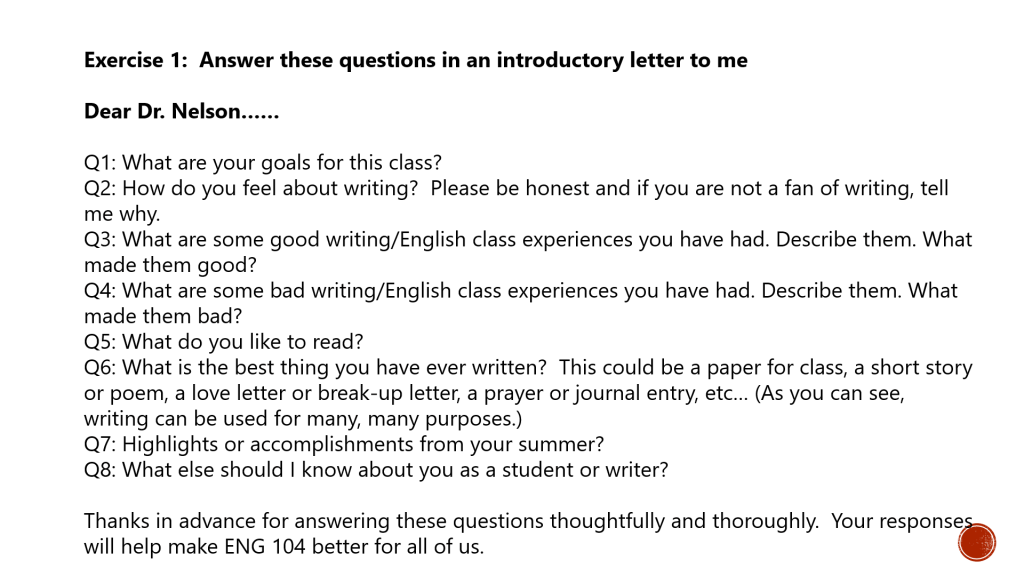
Exercise 1: After I show students an introductory PowerPoint outlining why learning to write is important, stating my goals for the class (what I hope they will learn), and introducing them to the “Rhetorical Situation” I want them to consider for everything they write, I ask them to write me an Introductory Letter, answering these questions:

Dear Professor Nelson……

Q1: What are your goals for this class?
Q2: How do you feel about writing?  (please be honest and if you are not a fan of writing, tell me so and tell me why)
Q3: What are some good writing/English class experiences you have had. Describe them. What made them good?
Q4: What are some bad writing/English class experiences you have had. Describe them. What made them bad?
Q5: What do you like to read?
Q6: What is the best thing you have ever written?  This could be a paper for class, a short story or poem, a love letter, break-up letter (or email or text), a prayer or journal entry, et cetera.
Q7: Highlights from your break (winter or summer)?
Q8: What else should I know about you as a student or writer?

Thanks in advance for answering these questions thoughtfully and thoroughly.  Your responses will help make ENG 104 better for all of us.

Exercise 2:What is “Good Writing?”

First, I ask students to freewrite 8-9 minutes answering the question, “What is Good Writing?” Then I ask students to share some of what they wrote, writing their responses on the board, and briefly discussing these responses. Then I break the class into groups, and give them this task:

Your group’s objective is to come up with one dictionary style definition of “good writing” (this should be a universal definition that can apply to novels, essays, instruction manuals, et cetera)

Here are some examples of definitions:

mammal: a warm-blooded vertebrate animal of a class that is distinguished by the possession of hair or fur, the secretion of milk by females for the nourishment of the young, and (typically) the birth of live young.

language: the principal method of human communication, consisting of words used in a structured and conventional way and conveyed by speech, writing, or gesture.

You don’t have to point out that they are mammals using language, but some students will appreciate the choice of examples. 

Let the groups work a while on their own then go around the room and check their definitions, making suggestions as needed. No groups will come up with the perfect definition and that’s okay. Once they have a definition they are satisfied with, either have one member of the group write it on the board or have one student email it to you (and you can use the projector to share them with the class). (10-15 minutes) 

Once all definitions are available for viewing, have one group member read it aloud and then you can respond (or ask students questions) and discuss the strengths and flaws of the definition. (10 minutes)

At the end of the session, collect all the definitions (paper copies or email) and tell students you will work on combining the best of all the definitions to come up with a strong definition of “good writing” you all agree on and can use for the rest of the semester and you’ll bring it to an upcoming class session.

This is a good way to get students working in groups, with a specific task. You can complete this in a 50-minute class. Along the way, you will learn more about what they value, or what they’ve been taught to value, in writing (and what you have to teach and maybe unteach them). You get to model the thinking/writing/revision process that you want students to engage in all semester. This also helps (as other early-semester assignments do) that this is “their” class, not just yours. Specifically, this exercise lets them feel like they have come up with a definition of good writing (they are, but with your help) and later in the semester, you and they can both refer back to this for every assignment to help determine if they are producing and submitting “good writing.”

Assignment 1:  Photo Essay

For this exercise, choose a recent photo of yourself and write a short essay telling the story behind the picture. Your objective is to write expansively on the moment of the photo, making it as interesting as possible. You may tell your reader what was going on in your mind at the time (consciously and otherwise), where have you just come from, where are you going, who is with you in the picture, who took the picture, why is this an important moment in your life, et cetera.

As you tell the story, you should also try to bring the scene to life by describing the physical setting of the photo, using a variety of sensory details (sight, sound, smell, taste, touch). The most effective way to bring the scene to life for your reader is to SHOW, not just TELL what is going on (for example, instead of saying “It was very hot” try something like “I could feel the sweat dripping down my back”). 

Keep in mind that your reader needs to be provided with all necessary background information (who, what, where, when, why, and how) to make sense of the story you tell.

After reading the essay, readers should have a good sense of the experience you are describing, understand why it was important for you, and feel like they know you a little better (your personality, history, interests, likes and dislikes, etc.)

Write this essay in first-person point of view (I….).

Your essay must be typed and double-spaced. Aim for at least 2 pages. Aim well. Bring a copy of your photo on a separate sheet of paper. These photos will be used for an in-class writing exercise so please bring a photo you are comfortable sharing with the class.

Rhetorical Situation: 
Your authorial voice:  You, the subject of the photo, who wants to tell the story behind the experience captured in the photo
The content: A detailed, description of the experience captured in the photo
Your audience/reader: Someone who is interested in reading about your experience but has no prior knowledge of who you are, what the experience was, when you had this experience, who you were with, et cetera
Your objective: Your goal is to bring this experience to life for your reader in an engaging way, so your reader understands your experience and remembers it clearly after reading your essay.

This should be a fun assignment for the students. The keys are that the essays need to be descriptive, include lots of specific details, and provide all necessary background information (taking the readers’ needs into consideration–so anticipate making comments along these lines when you grade the papers). I have found this to be a great way to get students writing and learn a little bit more about them. It’s also provides great material for an in-class exercise (details in Exercise 3).

Exercise 3:  In-class creative writing exercise

Students should have completed Assignment 1 and brought the photo the essay was based on to class. Here are the instructions for students:

For this activity, you will exchange photos (just pass them around the room so you do not have the photo of the person sitting next to you or someone you already know).  For 8 minutes (per photo—we will do this 3 times), you are going to describe the story of the photo just as you did with your own for the Photo Essay you wrote for today’s class. The difference, of course, is that for today’s exercise you do not know the story behind the picture and need to create it. So begin by looking at the details of the photo and then you can either:  1) try to imagine/guess as accurately as possible what really was going on when the photo was taken or 2) be as creative as you want to be and come up with a story (as crazy or farfetched as you want it to be). The only rule for this exercise is to keep writing for the full 8 minutes (until I tell you to stop) (I will let you know when there are 2 minutes left) and, as you did with your Photo Essay, be specific, use as many sensory details as possible, Show, don’t Tell, and try to keep your reader as engaged as possible by making the story interesting. This should be written in first-person POV (I……).   So for 8 minutes, leave you identity behind and take on the identity of the person in the photo. Have fun!

Note to Instructors: This is a fun class session where students get to do some creative writing and also get to know each other a little better.  The first thing I do is make sure that if there is more than one person in the photo, students identify themselves (draw an arrow pointing to themselves). For the distribution of the photos, just make sure they are not writing about the person sitting next to them.  After all 3 8-minute (or 10 if you’ve got the time) writing sessions, ask students to return the photos to their owners, then ask for volunteers—either students can volunteer to read what they wrote in class about a specific photo or they can volunteer their photo and hear what others wrote about it (to encourage volunteers, I tell them this is the only way they’ll find out what others have written). If there are not enough volunteers, you can choose photos that look interesting/you want to hear about. Whichever way it is decided, there should be 3 readers for each photo (identify them all before the reading begins) and after these students read what they have written in class, ask the subject of the photo to briefly explain the real story behind the photo (I used to have students read the essays but it takes too long—it’s better to cover more photos (ideally with different readers). 

I’ll also present Assignment 2 on this day at the end of class. Here’s the Assignment Sheet:

Assignment 2:  Summary of “Self-Reliance”

A summary is a condensed version of another author’s text. You provide a summary to present another author’s ideas to your reader. When presenting the ideas from your source, do so objectively (don’t agree or disagree or comment on the text or present your own examples to help explain it—just tell your reader what the source writer is saying). You will need to do this often in both your academic writing and in your career.

Your summary should be a combination of paraphrase and direct quotations. A paraphrase is the source writer’s ideas in your own words. A quote is a word-for-word presentation of the other writer’s words. Use quotes to emphasize the most important parts of the work you are summarizing or when you don’t believe you can accurately convey the ideas in your words.

For this assignment, aim for 3+ pages and include 6-8 short quotations.

When you present quotes, use a signal phrase as in:

Emerson says, “Envy is ignorance” (2).  (the underlined portion is the signal phrase (use present tense for MLA format)).

When you are paraphrasing Emerson (presenting his ideas in your own words) do not present more than two words in a row from the essay without using quotes or this is a form of plagiarism.

Keep in mind your goal is to accurately sum up Emerson’s argument, writing as if your reader has not read “Self-Reliance.” To provide a good summary, answer the following questions (though you do not need to limit yourself to these):

  • How does Emerson define self-reliance? 
  • According to Emerson, why is it difficult to be self-reliant? 
  • What are the benefits of being self-reliant? 
  • What are the negative consequences of not being self-reliant?

“Self-Reliance” was not written in academic form, with a thesis statement, but for your summary, you need to write a “thesis statement” for “Self-Reliance.” This should come at the end of the first paragraph of your summary (the end of the introduction, which can be brief for this paper).  You may not know what the thesis statement/argument is until you have written a draft of the summary but it should look something like an answer to these 4 questions, something like this:

According to Emerson “Self-Reliance” is….  It is difficult to be self-reliant because….. However, the benefits of being self-reliant are….and those who are not self-reliant……. 

As you can see, a well-developed thesis statement may be made up of multiple sentences. Your thesis statement should also preview the order/organization of subtopics/ideas in the paper.

As you read, be sure to take notes, which may include questions, comments, observations, and definitions of words you’ve looked up. This is a challenging essay so please plan your time accordingly.

Also, though you are only writing a summary for this assignment, not responding to Emerson’s argument, we will do that in upcoming class discussions and you will write about your responses in a later assignment, so keep those in mind and take notes for yourself as you read (for example, do you agree with Emerson’s argument? Disagree? Why? How do his ideas relate to your life and society today?).

Rhetorical Situation

Your authorial voice:  You are familiar with the source you are summarizing (in this case, you have read “Self-Reliance” and thought about Emerson’s argument) and you are presenting it objectively (not responding to the argument) (when writing a summary, think of yourself as acting like a channel through which the original source is being heard).
The content: A condensed version of the argument the source presents, with some quotes highlighting key points from the source.
Your audience/reader: Someone who is not familiar with the source (in this case, someone who has not read “Self-Reliance.”)
Your objective: Your goal is to explain the main argument/key ideas of the source to your reader. After reading your summary, your reader should have a good idea what the key points of Emerson’s argument are.

Exercise 4:  Quotation, paraphrase, and thesis statements

The first part of this exercise is designed to show students how I want them to present quotations and paraphrases for Assignment 2 (and throughout the semester). The second part is to introduce them to thesis statements (I’ve included then Thesis Statement handout as well)

  1. Present a direct quote from paragraph 1 of “Self-Reliance.” Do this in three parts:  introduce the quote (be sure to identify the author in a signal phrase), present the quote (and page #), then respond to/explain the quote.
  • Paraphrase (restate in your own words) the following passage from page 2 of “Self-Reliance”:

“There is a time in every man’s education when he arrives at the conviction that envy is ignorance; that imitation is suicide; that he must take himself for better, for worse, as his portion; that though the wide universe is full of good, no kernel of nourishing corn can come to him but through his toil bestowed on that plot of ground which is given to him to till.”

  • Write a thesis statement in response to one of the questions below.  In your thesis statement, first present the counterargument, then provide at least 3 reasons supporting your position:

For example, a thesis statement in response to the question:  Should a writing class be required for all first-year college students? may be:

“While some may argue that college students get enough writing practice in their other classes, a writing class should be required for all students because it will help them develop an efficient writing process, they will learn the value of revision, and let’s face it, students have loads of fun in these classes.”

Should people be allowed to keep pit bulls as pets?  Why/why not?
Should motorcycle riders be required to wear helmets? Why/why not?
Should college students be Facebook friends with their parents? Why/why not?
Should grade-school children have daily homework?
Which sport is the toughest to compete in?
Should a literature class be required for all college students?
It is better to have loved and lost than never loved at all?

Exercise 5:  Sentence Outline

For today’s in-class group exercise, you will create a sentence outline/reverse outline for the article “The future of writing is the future of thinking!” The purpose of this is to help you see the specific points a paper makes and see how these ideas are organized. You will do this with some of your assignments later in the semester (and it is also a helpful tool for reading comprehension)

After reading the full essay, go back through the essay, paragraph by paragraph, and write out that main point for each in one complete sentence.  

The article I’ve been using for this is “The future of writing is the future of thinking!” by Anand Tamboli (I shorten the paragraphs to make it twelve). But you can use any short, relevant reading for this exercise.

Exercise 6: Pre-Writing Outline for Assignment 2

I’m using this exercise for the first time this semester and it has helped improve students’ drafts of Assignment 2. It feels a little prescriptive but this assignment is a summary with very clear objectives (and don’r worry, some students will still not submit a draft with a good thesis and/or quotes in the right place). I print this on both sides of a paper and check them (this day if there is time or at the start of the next class while students are working on Exercise 7.).

4-part thesis statement for Assignment 2:

Emerson defines self-reliance as:
He says it is difficult to be self-reliant because:
The benefits of being self-reliant are:
The negative consequences for not being self-reliant are:

Quotes that support Point #1:
Quotes that support Point #2:
Quotes that support Point #3:
Quotes that support Point #4:

Exercise 7:  Practice Peer Review for Assignment 2

For this exercise, I give students’ papers from previous semesters—ideally one that has a number of issues (mistakes I don’t want students to make) and one that is better. We read the papers aloud (one paragraph at a time) then I have the students work in groups writing out the peer review sheet and then we discuss the papers and their comments as a class.

Here are the instructions I give them and the questions on the peer review sheet (which will also be the sheet I use to grade their papers):

In addition to providing comments on the paper you are reviewing, answer each question with 2-3 complete, well-developed sentences.  Do not use the words/phrases from the question in your answers. For example, for question 1, do not simply say “the intro introduced the topic and engaged me as a reader”. Instead, refer to the specific ideas in the paper you are reviewing and/or explain why you are answering the question as you are.

Grading Rubric Assignment 2

Does the introduction introduce the topic and engage the reader?

Does the paper have a clear, well-developed thesis statement that presents Emerson’s argument and accurately previews the organization of the paper?

How well does the paper present Emerson’s argument?  Would a reader who has not read “Self-Reliance” understand Emerson’s main points?  Does the paper provide enough specific details and explain key ideas from “Self-Reliance” clearly and thoroughly?

Does the paper include relevant quotes that help make Emerson’s argument clear to the reader? Are the quotes introduced properly? Are there enough quotes? Too many? Too few? Does the writer explain the quotes for the reader’s benefit? 

Is the paper well organized?  Are paragraphs appropriate lengths and do they focus on different subtopics from the essay? Does each subtopic relate to the thesis?  Do paragraphs begin with topic sentences?  Are transitions between paragraphs (and ideas) smooth?

Rate the paper’s grammar, clarity, and readability:

Needs improvement (lots of mistakes and confusing sentences                                                             

Developing (readable, but needs substantial improvements                                                          

Proficient (only minor revisions needed)

Advanced (a pleasure to read and I couldn’t find any errors)

Does the paper stay focused on objectively presenting Emerson’s argument (which means not agreeing or disagreeing and not presenting ideas or information that is not in “Self-Reliance”)?

Does this paper have a conclusion that sums up the main points, restates the thesis statement, and leaves a lasting impression?

Other comments or suggestions for revision:

Exercise 8: Examples of “Good” and “Bad” writing

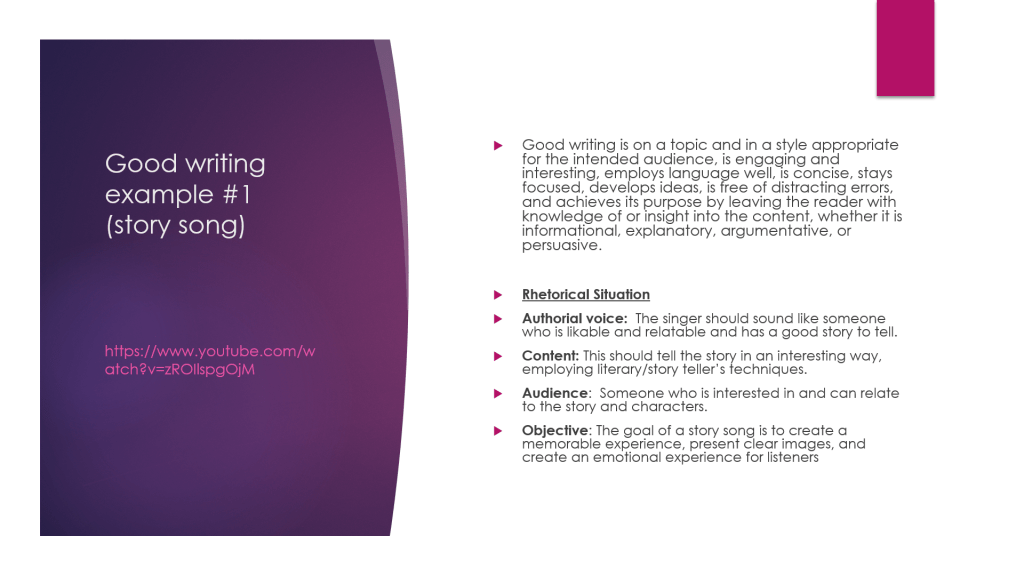
First, I give the class our “class definition” of good writing, which is something like this:

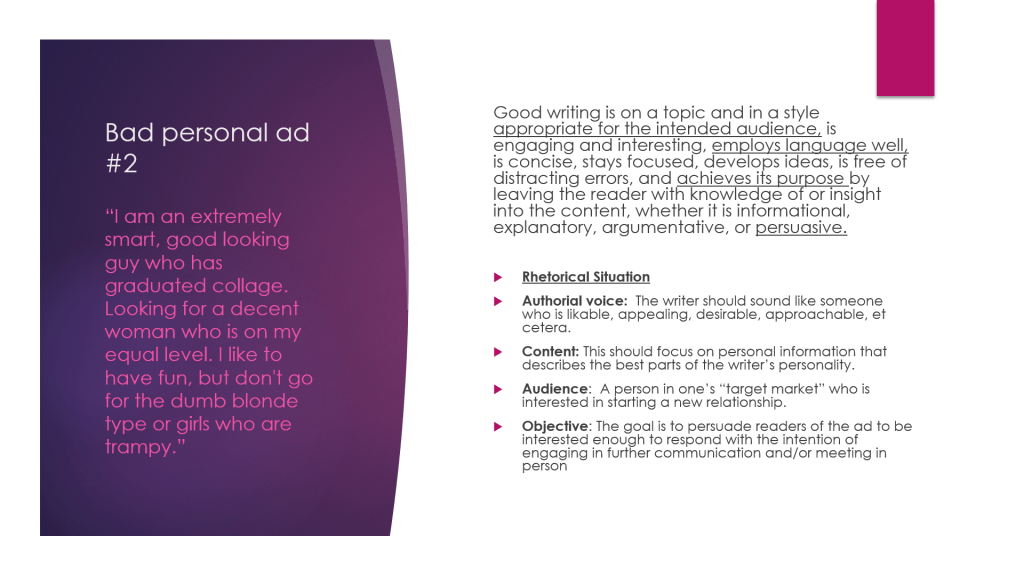
“Good writing” is on a topic and in a style appropriate for the intended audience, is engaging and interesting, employs language well, is concise, stays focused, develops ideas, is free of distracting errors, and achieves its purpose by leaving the reader with knowledge of or insight into the content, whether it is informational, explanatory, argumentative, or persuasive.

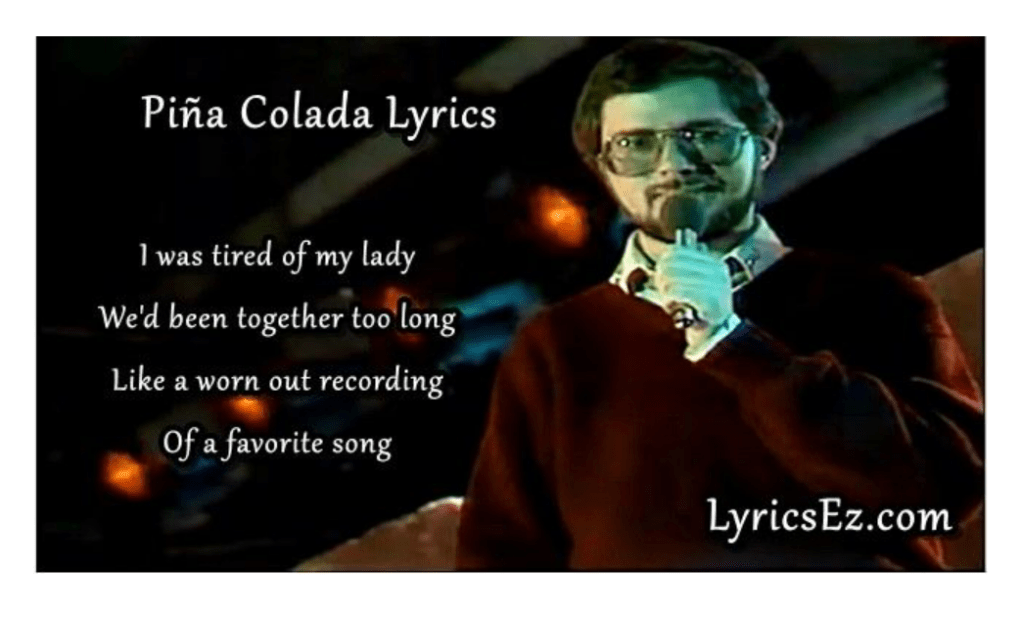
Then I ask them (any time over the course of the semester)to submit at least 3 examples of good or bad writing with a brief explanation. I present a “What is Good Writing?” PowerPoint (this is described in more detail in an earlier post) with the defintion of “good writing” and some examples of bad writing (some funny personal ads I found) and one example of good writing (“Escape” (the Pina Colada Song) by Rupert Holmes. I time it to show a video of Holmes singing the song at the end of class (it’s a great way to send them out).  Did you know Holmes is now a best-selling, award-winning author??

Exercise 9: Peer Review of Assignment 2. 

Students bring 4 copies of their rough drafts to class, I collect them all, then break students into groups (ideally 3) and give them a paper to read and give feedback on (same questions as Exercise 7). When groups are done, I go to the group and review the peer review sheet to make sure it is complete and will be helpful for the writer. While students are working, I’ll read over the openings of all the papers to review the thesis statements (and more if there is time). One challenge of this exercise is keeping all the papers organized and with the proper peer review sheets (so ask students to write some identifying info on the peer review sheet–title, student’s name (if it’s there though I tell them they do not need to include their names on the drafts), or the opening sentence).

Exercise 10:  SHOW, don’t TELL exercise with Benjamin Franklin quotes

Below are a number of Benjamin Franklin’s famous aphorisms (an aphorism is a terse saying embodying a general truth or observation). To make sense of these, you must think about the quotations before the full meanings become clear.

For today’s exercise, each group will select two of the quotes. First, think about the quote then write in your own words what you think Franklin means (this is TELL-ing your reader what it means). Secondly, provide a real-life (actual, not hypothetical) example that SHOWS (not just tells) what the quote means. You must write in complete, grammatically correct sentences.

For example:  “When the well’s dry, you know the worth of water.”

  • This means that people don’t appreciate what they have until they don’t have it anymore (or need it). 
  • For example, “I didn’t realize how valuable the peer review process was until I had to write a paper for my History class. I made a number of mistakes in my paper but didn’t realize it until it was graded. I got only a 68 and it was too late to do anything about it.”

Choose 2 of these:

“He that lives on hope will die fasting.”

“Do you love life? Then do not squander time, for that’s the stuff life is made of.”

“Sloth, like rust, consumes faster than labor wears; while the used key is always bright.”

“If Jack’s in love, he’s no judge of Jill’s beauty.”

“Genius without education is like silver in the mine.”

“Time enough! Always proves too little.”

“Diligence is the mother of good luck.”

“’Tis easier to surpress the first desire than to satisfy all that follow it.”

“Employ thy time well if thou mean to enjoy leisure.”

“We may give advice, but we cannot give conduct.”

Exercise 11:  Rhetorical Analysis

For this exercise, first give brief explanation of ethos, pathos, and logos. Then the class should read a short essay or article to analyze. I’m including the handout I give to groups. After all groups are done, we discuss this as a class.

What is the writer’s main point/thesis/argument? (write a thesis statement (position + reasons) for this article)

Who is the intended audience? Why do you believe this is the intended audience?

What is the writer’s objective/how does the writer want readers to respond?

For all of the following, discuss and be prepared to explain why the examples you list are examples of ethos, pathos (identify the specific emotion being activated) and logos.

Ethos example #1:

Ethos example #2:

Ethos example #3:

Pathos example #1:

Pathos example #2:

Pathos example #3:

Logos example #1:

Logos example #2:

Logos example #3:

Finally discuss the effectiveness of the writer’s use of these techniques, making references back to examples you have presented and explain why they are or are not effective. Which technique did the writer use most effectively? Least effectively?

Exercise 12:  Academic Conversation on “Grit”

This is intended to be an introduction to an Academic Converstation. We watch Angela Duckworth’s famous TED Talk on “Grit” and I pass out 5 different articles (1 per group), each responding to Duckworth’s TED Talk in a different way. This exercise can be completed on a different theme (with different readings) that better match your course theme.

Here’s the handout I give students:

For today’s in-class exercise, we will watch Angela Duckworth’s TED Talk“Grit:  The Power of Passion and Perseverance.” Then, in groups, you will look at some other articles and studies that “joined the conversation” about Grit (similar to what you will do for your upcoming Research Paper). We’ll discuss the content/arguments of these articles, come up with thesis statements for them, and share these with the class. We will also discuss the strength and/or weaknesses of the arguments, and (if time allows) engage in Rhetorical Analyses of the arguments.

By the end of today’s class, you should have an introductory understanding of Duckworth’s argument about “Grit” (and see why others say it is/is not the key to success), get an idea of what an “academic conversation” looks like, and further develop your undestanding of Rhetorical Analysis.

After everyone in your group has read your group’s article, answer these questions:

What is the writer’s main point/thesis/argument? (write a thesis statement (position + reasons) for this article). In what ways does this agree/disagree with Duckworth’s argument in her TED Talk?

Assignment 3:  Personal Letter to Ralph Waldo Emerson

I make sure my students remain objective in Assignment 2 and don’t respond to Emerson’s ideas in “Self-Reliance” (though they do when we discuss the essay in class). Then for this assignment, they must respond and make connections between Emerson’s ideas and their own lives and the lives of those around them. I have them write this in a letter, which allows them to be less formal and more creative and also adds a new set of challenges for them as writers because they have to explain contemporary society to Emerson (who for the purposes of this assignment, is still living in the 1840’s). Here is the assignment sheet:

Assignment 3: Now that you have read “Self-Reliance” and written a summary, I’m going to ask you to think and write about some of Emerson’s ideas in a different way—a 3-4 page letter to Emerson.

For this letter, imagine Emerson is back in 1841 and you are writing to him from the present (2024, obviously) and letting him know how people in society today are doing in terms of being self-reliant, avoiding conformity, thinking for themselves, living in the present, et cetera (all the things he is trying to motivate readers to do in his essay). 

A key for this assignment is to be specific when you explain contemporary society to Emerson (you can call him Ralph for this assignment if you want to) because he won’t know what Facebook, snapchat, TikTok, and even television are (you don’t have to go too far explaining how the technology works but make it clear that this sort of communication is now readily available and very popular). Remember to SHOW, not just TELL Emerson what life is like in 2024.

You can talk about social media, politics, religion, education, or whatever else comes to mind. Do you think Emerson would be happy with the way people are living their lives? In the battle between self-reliance and conformity, which side is winning? What have you found to be the key influences in promotion of both self-reliance and conformity (education, religion, friendships, social media, family, etc.)

You can also reflect on and discuss your own behaviors, attitudes, choices, et cetera as they relate to self-reliance and conformity? Would Emerson approve of the way you are leading your life?

I hope that framing this as an informal letter will be a fun assignment for you and lead you to some new ideas about “Self-Reliance” and how Emerson’s ideas relate to our lives in society today and your life in particular. Aim for 3-4 pages (but if you have more to say, keep writing because Emerson love to read!).

However, I do want you to end your opening paragraph with a thesis statement that sums up your argument/previews the subtopics you will discuss in your letter. For example:  Ralph, the key things I want you to know about how people are living in 2024 are……. 

For this assignment, my advice is to write a draft of the letter first, using the act of writing to discover what you want to say to Emerson, then go back and identify the subtopics/main points you have made in the letter, then write a thesis statement, going back and revising/reorganizing the letter to match the thesis as needed.

Rhetorical Situation

Your authorial voice:  You are a college student in 2024 writing about your own personal and unique perspectives on your life and the ways others are operating in society today in terms of being self-reliant and/or conformist.

The content:  A detailed description and analysis of how people are operating in society today in terms of being self-reliant and/or conformist, with specific examples that SHOW how people are/are not being self-reliant and maybe how this is affecting them (for better or worse).

Your audience/reader: It’s Ralph Waldo Emerson, sitting at home in 1841, with no idea what’s coming in your letter.

Your objective: Your goal is to explain to Emerson how people think and act today in terms of being self-reliant. You want to explain to him what society is like in 2024 (different in many ways than it was in 1841 but also similar in other ways) and let him know whether or not his pleas about the importance of self-reliance captured in his essay were heard and followed, or not. Let him know if he would be proud of the way people act and think today, or not.

Exercise 13: Introduction to Logical Fallacies

For this exercise, we first watch a video on logical fallacies (there are lots of good ones) and I give them this handout (the fallacies we’ll focus on) and ask them (in groups) to identify the fallacy in the statements. I collect these and check them, giving them back to students as many times as possible (sometimes over the course of weeks) until they have identified them all correctly. Here is the handout:

Below is a list of logical fallacies followed by a list of fallacious statements. Your group needs to identify the fallacy being committed in each.

Bandwagon appeals:  Urging the audience to go along with the crowd and/or the popular choice.

Red Herring:  Introducing an irrelevant topic into an argument to divert the attention of listeners or readers from the original issue

Circular Reasoning:   Trying to support an argument by simply restating it in other words.

Straw man:  Setting up a weak counterargument that can be easily attacked.

Tu Quogue: Saying someone shouldn’t be listened to because he or she has done the thing he or she is arguing against.

Appeal to Ignorance:  Telling people to accept a conclusion because there is no definitive proof for either side of the argument.

Appeal to Authority:  Trying to convince the audience by referring to or getting a testimonial from a famous person (who is not an authority on the subject).

False Dichotomy/ Either-Or:  Arguing that only two alternatives are possible, even though the argument is more complex than that.

Slippery slope:  Contending that if an event occurs, it will set in motion a chain of events that will lead to something much worse happening.

Ad hominem:  Making a personal attack rather than addressing the position being argued.

Hasty generalization:  Jumping to conclusions without sufficient evidence and/or relying on stereotypes to assess individuals.

Begging the question:  Presenting an argument as true without any support or evidence to support it.  

Faulty analogy:  Making a comparison that does not hold up to the argument it is supporting.

The Relativist Fallacy:  Claiming that something is true for most people is not true for a particular person.  

Non-Sequister/Missing the Point: Moving an argument in a nonsensical direction or reaching the wrong conclusion.

Complex Question Fallacy: Posing a question which implies something that has not been proven.

Appeal to Emotion:  Trying to get people to accept a conclusion by making them feel strong emotion, typically pity or fear.

False Cause:  Mistakenly assuming that because one event followed another, or happened at the same time, the first event caused the second.

“Love is the most powerful feeling because it’s the strongest emotion in the world.”

“Let’s skip class and go down to the beach. Come on, everyone else is doing it.”  

“You want to know what I think about your new boyfriend? I think the Packers are going to win the Super Bowl this year.”   

“You can’t tell me how to be a good person. You are a proven liar and cheater.”      

“I know gun rights supporters are concerned about the number of good jobs that the gun industry provides, but the economy will adapt to a gun-free society and provide lots of even better jobs.”      

“Kim Kardashian says green grapes are the healthiest fruit so you should add them to your diet.”     

“You either support university athletics or you hate the university.”   

“Soccer is the toughest sport.  No one has proven otherwise.”     

“If we allow same-sex marriage, soon we will have to allow people to marry siblings, pets, and inanimate objects.”   

“Former Congressman Anthony Weiner got caught sexting again—all politicians are crazy!” 

“I don’t think those who sign up for Army Reserve should be forced into combat. I lost both of my sons in Iraq because of that.”     

“Restricting access to handguns is like restricting access to automobiles—they both lead to thousands of deaths a year.”    

“What do I think about Trump’s performance as President?  I think he’s a deplorable human being!  

“Everyone knows English majors are the smartest students.”   

“Most students may need to revise their papers to earn a good grade, but I don’t have to.”

“So, how often do you lie to your parents?”     

“In the summer, ice cream sales go up and so do violent crime rates. Therefore, ice cream must make people more violent.”     

“Whenever I don’t study, I get bad grades. God must be punishing me for something.”   

Exercise 14:Peer Review/Grading Rubric for Assignment 3

As with Assignment 2, students need to bring 4 copies of their draft for Peer Review. I follow the same process as the last time. If the groups worked well the last time, I’ll let them stay in those groups, but if not, I’ll have them form new groups.

Here is the Peer Review sheet (again, also the Grading Rubric–which is important to share with students before they submit their papers for grading):

Is there a clear “thesis statement” that identifies the subtopics that will be discussed and previews the organization of the letter?

Does the letter stay focused on explaining the writer’s experiences and observations as they relate to self-reliance and conformity is society today?

Is the letter well organized?  Are paragraphs appropriate lengths and do they focus on different subtopics? Are transitions between paragraphs (and ideas) smooth?

Has the writer provided enough explanation and background information so the reader (Emerson) will not be confused and/or left with questions such as:  Who? What? Where? Why? When? How? (make a note of sections where the writer needs to provide more explanation and/or background information)

Does the letter develop ideas with enough detail and examples so it is clear how the writer and/or others the writer has observed in modern society are or are not being self-reliant (and how this is affecting them for better or worse)?

Rate the letter’s grammar, clarity, and readability:

Needs improvement (lots of mistakes and confusing sentences                                                            

Developing (readable, but needs substantial improvements                                                           

Proficient (only minor revisions needed)

Advanced (a pleasure to read and I couldn’t find any errors)

Does this letter have a conclusion that sums up the main points, restates the thesis statement, and leaves a lasting impression?

Was this letter engaging (that is, did it hold your interest as you read it)?  Why or why not?

Was this letter interesting and memorable (that is, does it go beyond the obvious and did you learn new things about either “Self-Reliance” or the way people think and act in society today)? Did the ideas expressed in the letter make some kind of lasting impression?  Why or why not?

Other comments & suggestions:

All right, that’s it for now. I”ll update likely twice more during the semester to share all 15 weeks of fun.

Featured

Sabbatical Post….

As you may have noticed, I’ve been away from this blog for a while. Last semester, I had such great and seemingly attainable plans to post the full 15 weeks of assignments and exercises for my composition classes. But once I got papers to grade, which I think was Week 3, well, I was pretty busy and guess I (rightfully so) valued spending time helping my students over any other ventures and just stopped posting. If you were looking forward to getting details on full semester, I do apologize. However, I am eager to share my ideas and plan to “publish” in one way or another, a full 15-week assignment sequence, with details on both in-class and out-of-class exercises and assignments as well as explanations for why I am assigning these and what I hope to accomplish with each (I’ve also got some good ideas for changes next semester). I’m on sabbatical this semester (my first ever) and am focusing on creative writing but I will find time to get this assignment sequence all together and ready for consumption. In the meantime, please email me at steve.nelson38@yahoo.com if you have any questions. And for those of you who were able to attend my presentation at the CCCC Conference in Chicago last week, thanks again for attending and I hope you found the presentation and find my book helpful. The slides from the Powerpoint are available for conference attendees on the Whova app. Keep up the good work.

If you to read more about my teaching, check out my other blog posts or my book Teaching The Way:  Using the Principles of The Art of War to Teach Composition:  https://amzn.to/3mwbz3y

Featured

All my secrets revealed: Week 2

Day 3:

First off, Assignment 1 is due on this day. I’ll let you see that first so you can better understand the in-class exercise.

Assignment 1:  Photo Essay

For this exercise, choose a recent photo of yourself and write a short essay telling the story behind the picture. Your objective is to write expansively on the moment of the photo, making it as interesting as possible. You may tell your reader what was going on in your mind at the time (consciously and otherwise), where have you just come from, where are you going, who is with you in the picture, who took the picture, why is this an important moment in your life, et cetera.

As you tell the story, you should also try to bring the scene to life by describing the physical setting of the photo, using a variety of sensory details (sight, sound, smell, taste, touch). The most effective way to bring the scene to life for your reader is to SHOW, not just TELL what is going on (for example, instead of saying “It was very hot” try something like “I could feel the sweat dripping down my back”). 

Keep in mind that your reader needs to be provided with all necessary background information (who, what, where, when, why, and how) to make sense of the story you tell.

After reading the essay, readers should have a good sense of the experience you are describing, understand why it was important for you, and feel like they know you a little better (your personality, history, interests, likes and dislikes, etc.)

Write this essay in first-person point of view (I….).

Your essay must be typed and double-spaced. Aim for at least 2 pages. Aim well. Bring a copy of your photo on a separate sheet of paper. These photos will be used for an in-class writing exercise so please bring a photo you are comfortable sharing with the class.

Rhetorical Situation: 
Your authorial voice:  You, the subject of the photo, who wants to tell the story behind the experience captured in the photo.
The content: A detailed description of the experience captured in the photo
Your audience/reader: Someone who is interested in reading about your experience but has no prior knowledge of who you are, what the experience was, when you had this experience, who you were with, et cetera.
Your objective: Your goal is to bring this experience to life for your reader in an engaging way, so your reader understands your experience and remembers it clearly after reading your essay.

This should be a fun assignment for the students. The keys are that the essays need to be descriptive, include lots of specific details, and provide all necessary background information (taking the readers’ needs into consideration–so anticipate making comments along these lines when you grade the papers). I have found this to be a great way to get students writing and learn a little bit more about them. It’s also provides great material for an in-class exercise (details in Exercise 3).

Exercise 3:  In-class creative writing exercise

Here’s how I explain this exercise to students:

For this activity, you will exchange photos (just pass them around the room so you do not have the photo of the person sitting next to you or someone you already know).  For 8 minutes (per photo—we will do this 3 times), you are going to describe the story of the photo just as you did with your own for the Photo Essay you wrote for today’s class. The difference, of course, is that for today’s exercise you do not know the story behind the picture and need to create it. So begin by looking at the details of the photo and then you can either:  1) try to imagine/guess as accurately as possible what really was going on when the photo was taken or 2) be as creative as you want to be and come up with a story (as crazy or farfetched as you want it to be). The only rule for this exercise is to keep writing for the full 8 minutes (until I tell you to stop) (I will let you know when there are 2 minutes left) and, as you did with your Photo Essay, be specific, use as many sensory details as possible, Show, don’t Tell, and try to keep your reader as engaged as possible by making the story interesting. This should be written in first-person POV (I……).   So for 8 minutes, leave you identity behind and take on the identity of the person in the photo. Have fun!

This is a fun class session where students get to do some creative writing and also get to know each other a little better.  The first thing I do is make sure that if there is more than one person in the photo, students identify themselves (draw an arrow pointing to themselves). For the distribution of the photos, just make sure they are not writing about the person sitting next to them.  After all 3 8-minute (or 10 if you’ve got the time) writing sessions, ask students to return the photos to their owners, then ask for volunteers—either students can volunteer to read what they wrote in class about a specific photo or they can volunteer their photo and hear what others wrote about it (to encourage volunteers, I tell them this is the only way they’ll find out what others have written). If there are not enough volunteers, you can choose photos that look interesting/you want to hear about. Whichever way it is decided, there should be 3 readers for each photo (identify them all before the reading begins) and after these students read what they have written in class, ask the subject of the photo to briefly explain the real story behind the photo (I used to have students read the essays but it takes too long—it’s better to cover more photos (ideally with different readers). 

After this, I presented a PowerPoint (some slides below) with our final definition of “good writing.” I also included examples of good and bad writing (introducing another exercise I’ll have them complete over the course of the semester, which is finding good example of good or bad writing and submitting them along with brief explanations of why they are “good” or not. These examples can be from anywhere and to model this I show them four examples of poorly written personal ads and then one example of good writing–a video of Rupert Holmes singing “Escape: The Pina Colada Song. ” I telling them we should all aspire to write something as great as this song someday. It’s a great way to end class 🙂

Day 4:

We begin this class by reading and having a brief discussion on paragraph one of our first reading for the semester (“Self-Reliance”). We discuss some of the points Emerson makes and discuss the style, and I give them some tips for reading the whole essay and writing their summary (a draft of this is due Tuesday) (for this blog, I plan to add the Assignment sheets for the weeks assignments are due, though of course students get them in advance). Then we move on to Exercise 4, which is….

Exercise 4:  Quotation, paraphrase, and thesis statements

  1. Present a direct quote from paragraph 1 of “Self-Reliance.” Do this in three parts:  introduce the quote (be sure to identify the author in a signal phrase), present the quote (and page #), then respond to/explain the quote.
  • Paraphrase (restate in your own words) the following passage from page 2 of “Self-Reliance”:

“There is a time in every man’s education when he arrives at the conviction that envy is ignorance; that imitation is suicide; that he must take himself for better, for worse, as his portion; that though the wide universe is full of good, no kernel of nourishing corn can come to him but through his toil bestowed on that plot of ground which is given to him to till.”

  • Write a thesis statement (see attached handout on Thesis Statements) in response to one of the questions below.  In your thesis statement, first present the counterargument, then provide at least 3 reasons supporting your position:

For example, a thesis statement in response to the question:  Should a writing class be required for all first-year college students? may be:

While some may argue that college students get enough writing practice in their other classes, a writing class should be required for all students because it will help them develop an efficient writing process, they will learn the value of revision, and let’s face it, students have loads of fun in these classes.

             
Which sport is the toughest to compete in?  Why?
Is it better to have loved and lost, or never loved at all?  Why? 
Should people be allowed to keep pit bulls as pets?  Why/why not?
Should motorcycle riders be required to wear helmets? Why/why not?
Should college students be Facebook friends with their parents? Why/why not?
Should grade-school children have daily homework?

Here’s the handout on Thesis Statements

ENG 104 Thesis Statements  

A thesis statement:

  • States your argument (your position on a topic + your reasons)
  • Serves as a “road map” for the paper; previewing the organization of your essay
  • Directly answers the question asked of you (even if you’re not given a question, think of your thesis as an answer to a question).
  • Makes a claim that others might dispute.
  • is 1-2 sentences long and is presented at the end of the introduction (your first paragraph)

How do you get a thesis?

A thesis is the result of a lengthy thinking process. Formulating a thesis is not the first thing you do after reading an essay assignment. Before you develop an argument on any topic, you have to think about the topic, write about the topic, collect and organize evidence, look for possible relationships between known facts (such as surprising contrasts or similarities), and think about the significance of these relationships. Once you do this, you will probably have a “working thesis,” a basic or main idea, an argument that you think you can support with evidence but it will become more developed throughout the writing process.

How do you know if your thesis is strong?

When reviewing your first draft and its working thesis, ask yourself the following:

  • Do I answer the question?
  • Have I taken a position that others might challenge or oppose? If your thesis simply states facts that no one would disagree with, you are not making an argument.
  • Is my thesis statement specific enough?  If your thesis contains vague words like “good” or “successful,” be more specific: why is something “good”; what makes something “successful”?
  • Does my thesis pass the “So what?” test? If a reader’s first response is, “So what?” then you need to clarify, connect to a larger issue, or lead the reader to care about your position in some other way.
  • Does my thesis pass the “how” and “why?” tests? If a reader’s first response is “how?” or “why?” your thesis is too open-ended.

(handout adapted from: https://writingcenter.unc.edu/tips-and-tools/thesis-statements/)

This is a good in-class group exercise to help prepare students for the assignment due the next class session. It will minimize the number of quotation and paraphrasing errors (and make it easier for me to make comments on these when reading/grading papers) (and because I am using the text for the first reading for this exercise, it helps them understand some of the key ideas they’ll write about in the upcoming assignment). The thesis statement exercise is also valuable in helping them see how to write a thesis/organize an argument.

As far as the process during class goes, I explain the 3 tasks groups have to complete (showing the worksheet on the projector), then tell students who is in each group (3 or 4 students in each, ideally arranged facing each other), then tell them to get together and choose one of the questions for the thesis statements (keeping track so there are no repeats). After they have a designated question, I’ll hand out the worksheet, then give groups a few minutes to being working on these, then move around the class checking progress and making suggestions for changes, making sure by the end of the class that each group has correctly presented a quote and paraphrase and written a good thesis statement. If there is time, at the end of class, I’ll have students write the thesis statements on the board and/or read them aloud, making comments as is necessary to help them all see what makes a good thesis statement.

At the end of class, I showed them a short video. This time it was Brian Johnson’s “Philosopher’s Notes” This guy is such a big fan of Emerson he named his son Emerson and he gives a good overview of some key ideas from the essay. I also gave students links to other videos. I make it clear that they should not repeat anything from the videos in their summaries but I have found that watching these can help students who feel lost in the language and ideas to get some sense of what Emerson is saying (especially students whose first language is not English).

As promised, here is the Assignment Sheet for Assignment 1 (Photo Essay)

So that’s Week 2:

Effort Level: 7/10: Classes are fun and easy but I’m also grading papers (Assignment 1) this week, which (no way around it) takes time and effort. 

Enthusiasm Level: 9/10: I’m starting to get to know my students better, we’re having some shared experiences (among other activities, there’s no denying that listening to and watching a video of “The Pina Colada Song” in a dim room brings people together). I’m also getting excited about their experiences reading “Self-Reliance.”

If you to read more about my teaching, check out my other blog posts or my new book Teaching The Way:  Using the Principles of The Art of War to Teach Composition:  https://amzn.to/3mwbz3y

Featured

All my secrets revealed: Week 1

For this semester, I’m going to keep this simple, sharing the assignments my students and I worked on each week and indicating my perceived level of difficulty (for me, not my students), and my level of enthusiasm. I say I’m revealing my “secrets” because I think I’ve figured out how to to navigate a semester of teaching First-Year Writing and not only help my students become better writers but also keep myself fresh enough throughout the semester to remain energized and even (usually after a break) look forward to the start of the next semester. Over the course of the summer, I compiled, clarified, and added details to my assignment sequence and shared this with all the other composition instructors at my school, hoping they would use much of it (though making changes with their chosen course theme and readings) with their classes, so both them and their students would have positive experiences. Now I’m going to share it all with you….

I’m teaching 3 sections of composition class this semester and we meet twice a week (T & R). Here’s what we did Week 1:

Day 1: Introduction to ENG 104, Day 1 Powerpoint, Introductory Letter

The PowerPoint is intended to help motivate students, or (I tell them) at least better understand why I’m going to teach the class they way I am. I’ve found the letter-writing exercise (the last slide on the PowerPoint) to be a great way to start the semester. It helps establish the 1-on-1 relationships I hope to have with the students and lets them voice their initial thoughts and feelings about the class in an informal way. I think writing this letter helps them feel more comfortable if they establish (as many do) that they are not particularly excited about a writing class. They often reveal bad writing/classroom experiences they have had, which can help me understand why they may be reluctant to engage with a writing class. It also helps me get a sense of their writing abilities and a little bit about their personalities (moreso than any sort of oral ice-breaker activity) (and it’s a writing class, so better to write to introduce themselves). As you read these, highlight passages that are humorous, reveal enthusiasm or resistance, and anything else you think the class would benefit from hearing (I share these highlighted passages at the start of the next class session).

Day 2: In-class exercise: What is Good Writing?

After I read aloud some of the highlights from their letters to me (anonymously), I tell them a number of students stated a goal was to improve their writing, which leads me into the day’s exercise, being more specific about what that means (to become a better writer and produce “good writing”). To start, I write this question on the board and give students 7-8 minutes to write down their answers. Next, I’ll ask students to share some of those responses and write them on the board (sometimes clarifying them as I do) (and also asking them to briefly explain why they have provided the answer they have). Then, I’ll break them into groups (ideally 3 students per group) and tell them to share the rest of the answers with each other and take those, along with what I’ve written on the board, into consideration to come up with a definitive, all-encompassing definition of “good writing” that can apply to any type of writing.

To help them, I provide a couple examples of definitions:

mammal:  a warm-blooded vertebrate animal of a class that is distinguished by the possession of hair or fur, the secretion of milk by females for the nourishment of the young, and (typically) the birth of live young.

language:  the principal method of human communication, consisting of words used in a structured and conventional way and conveyed by speech, writing, or gesture.

I don’t point out that they are mammals using language, but I hope some students will appreciate this choice of examples. 

I let the groups work a while on their own, then go around the room and check their definitions, making suggestions as needed. No group will come up with the perfect definition and that’s okay. Once they have a definition they are satisfied with, I either have one member of the group write it on the board or have one student email it to me and use the projector to share them with the class.

Once all definitions are available for viewing, one group member will read it aloud and then I respond to them (or sometimes students ask questions) and we discuss the strengths and flaws of the definitions.

At the end of the session, I collect all the definitions (paper copies or email) and tell students I will work on combining the best of all the definitions to come up with a strong definition of “good writing” we can all agree on and use for the rest of the semester and that I’ll bring it to the next class session.

Really, I’ve already got a definition in mind, which looks like this: 

Good writing is on a topic and in a style appropriate for the intended audience, is engaging and interesting, employs language well, is concise, stays focused, develops ideas, is free of distracting errors, and achieves its purpose by leaving the reader with knowledge of or insight into the content, whether it is informational, explanatory, argumentative, or persuasive.

I’ve found this is a good way to get students working in groups, with a specific task (and this can completed in 50-minutes if you keep things moving and read the letter excerpts on a different day). I like this exercise because I learn more about what my students value, or what they’ve been taught to value, in writing (and it lets me know what I have to teach and maybe unteach them). I also get to model the thinking/writing/revision process I want students to engage in all semester. And this also helps show them (as other early-semester assignments do) that this is “their” class, not just mine. Specifically, this exercise lets them feel like they have come up with a definition of good writing (which they are, with my help) and later in the semester, and we can both refer back to this for every assignment to help determine if they are producing “good writing.”

So that’s Week 1:

Effort Level: 3/10: They are active but there’s not much work for me 🙂

Enthusiasm Level: 8/10: Of course, I’m excited to get the semester started, but really I’m transitioning from summer and I don’t know my students yet so I’m spending time with strangers, which is not my favorite thing to do. Of course, soon I’m getting to know them and when I do, it will make teaching the class easier and more satisfying.

If you to read more about my teaching, check out my other blog posts or my new book Teaching The Way:  Using the Principles of The Art of War to Teach Composition:  https://amzn.to/3mwbz3y

Thanks for reading!

Featured

Another semester in the rear-view mirror…..

My semester ended a week ago today and I’m almost in full summer-mode (as in, I think I have already forgotten half of my students’ names).  Though in many ways I’m always glad when the semester ends, my feelings are usually more mixed. I usually feel, along with gladness and relief, a sort of void, like I have some unfinished business I’ll never be able to get to. But this semester, because of my relatively smaller class sizes, I feel mostly just satisfied. This is because I had time to work closely with all my students on their final revisions (lots of times I’ll feel like I want another week or two before letting the semester go), had no students go MIA, and also had three students that had failed the course previously (one with me as instructor) pass this time with good grades. So it’s on the summer.

What are my plans?  Well, my first order of business is to revise our composition class again. We have used the John Warner book “The Writer’s Practice” the last two years but we are moving on from that. Even though it did not work as a solution to the problem (the problem being the unending quest to make this the best class possible), I’m glad we used and I plan to incorporate some of the ideas from that book going forward. But I want to get back to a version of the class closer to what I was teaching before these last two years and I want each instructor to choose a theme to focus on and have students write a variety of different assignments revolving around that theme. I believe this will give the students a more meaningful experience as they’ll be able to think and write more deeply about a topic and make more interesting connections. They will also be building momentum towards the research paper throughout the semester (which wasn’t the case with the assignment sequence built into the Warner book). At our end of the semester meetings and get-togethers, a number of my colleagues expressed dissatisfaction with their composition classes (for a variety of reasons but mostly related to a lack of engagement on the part of the students) and I hope the new version of it will help both them and their students. I’ll share more details on the assignment sequence when it is ready for public consumption.

In addition to that, I am hoping to spend a lot of time revising a novel (one last try for this one! (I think)), doing some yard work, spending time with my wife and kids, going for some bike rides and long runs and lake swims, et cetera, et cetera, all the things I love about summer (and about being a teacher).

So though I’m not really in a reflective mood, to provide some sense of closure, I will leave you with some of the reflective writing my students did at the end of the semester, which seems to indicate their experiences in composition class were valuable.

“Throughout the course of this semester, I greatly improved my writing process through outlines and revisions, strengthened my own voice and descriptive writing through various assignments, learned to correctly cite in MLA format during my research paper, and worked to stay concise keeping the reader engaged as I focused on the main idea that was driving my argument.”  (This student did a great job revising his research paper, improving his grade from 78 to 94 and earned an A in the class.)

“I am still not the biggest fan of writing papers, but at least I am better at it and the process goes a lot smoother. With every paper that was assigned, I have learned how to manage my time, organize my topics, and be as specific and clear as possible. After finishing Introduction to Writing, I have improved at writing well-developed thesis statements, including personal details in my papers, staying on topic, organizing the subtopics in my papers, and incorporating the practice of revision in my writing.” (This student also earned an A and is now an expert at writing thesis statements.)

“Before this semester, the idea of revising a paper felt pointless. I didn’t believe in a ‘rough draft,’ only a final draft. I thought this way because as I was “word vomiting” onto my paper, I didn’t want to take the time to reread my work and make revisions. I saved so much time planning my papers and this new time gave me the opportunity to look back and examine my work. I ended up enjoying the process of rereading my work and finding different ways to present the same information. It’s almost like a puzzle.” (This was one of my students who had failed the course previously. She did great engaging in the revision process, adding lots of details and information as she revised.)

“The process of writing forces us to stop and think about what we are doing. It helps us to understand and reflect upon our life and the decisions we have made to get to this point in our lives.” (Great observation!)

“Writing is not like other skills. It is one that has no end. Writing is always progressing, and writers learn along with it….There is always room for improvement.” (I agree!)

“A fool thinks he is the best at something, but a wise person understands and knows how little he really knows. If you know very little about a subject and only see the surface of what it is, it is easy to fall into the trap of thinking things are simple. Only after people see how it truly works do they begin to understand the complexities required to do something well and to be good at it.” (Though he doesn’t expressly mention writing here, I assure you that is what this student was talking about.)

If you to read more about my teaching, check out my other blog posts or my new book Teaching The Way:  Using the Principles of The Art of War to Teach Composition:  https://amzn.to/3mwbz3y

Thanks for reading!

Featured

Research Papers: Yes!

I am writing this on the day my students’ Research Papers are due and I’ve got to tell you, I’m excited. Yes, it’ll take some time to grade them, but I’ve been storing up energy the last few weeks while they’ve been expending it working on their papers. And I’m looking forward to it for three reasons:  1) it signals that the end of the semester is in sight, 2) I’m excited to see the progress my students have made over the course of the semester, and 3) I fully expect to learn a lot from my students’ papers.

The reason I expect to learn things is because my students write their papers on relatively unique topics, in attempts to answer questions they are genuinely interested in. I steer them towards these sorts of questions to make the process more meaningful for them, but I benefit too because their papers are better written and more interesting (and therefore easier to grade).

So, if you’re a writing teacher and want to know how to look forward to the day your students submit their papers for the same reasons I am, let me explain my process….

* * * * * * * * * *

Before my students choose a research topic, we brainstorm together. I’ll start us off with a general topic based on what we’ve read already (this changes, some semesters we read about social media, other times the formation of the self, others how the individual self and society interact with each other). I’ll share my list of possible research topics (50 or so) with the class and then have them add to it (10 or more) and share their new possible topics. This takes one class or less and after this, no matter what you want your students to focus on, they should have lots of possible interesting topics/ideas to choose from.

* * * * * * * * * *

The next thing I’ll do is have my students read sample Research Papers from previous semesters. I like to do this after they have begun to think about their own topics because as they read these papers, on some level, they will also be thinking about their own. The topics for these sample papers don’t matter. My goal is to show them examples of the type of paper they will be writing.

We also go over the Research Paper Rubric at this point and I have them fill out rubrics  for these sample papers (sometimes individually, sometimes in groups if we have time to do this as an in-class activity). Because the rubric is the same one that will be used for peer review and grading the paper, they are simultaneously getting a better understanding of the assignment requirements and looking closely at papers that (typically) succeed at meeting those requirements. If there’s time, we’ll read some bad papers too—so they can see what not to do.

* * * * * * * * * * *

The next thing they need to do is move from a general topic to a Research Question. I tell my students they are going to write an Inquiry-based Research Paper (which means starting with a question and following whatever leads they can find to help answer it). Many students come in to the class thinking that a research paper is a “report” and the focus should be finding information on a topic and presenting that. I tell them that while that may have been enough in the past, and may be true for some other subjects, that is not enough for the paper they will write for my class. Instead, they need to think about the paper as a sort of “conversation” about their chosen topic. However, I also tell them they can’t just present an aimless conversation, they need to answer their research question in the form of an argument, with their voice being the strongest, using the sources they find to help them answer the question, a question they can only “find” the answer to through a combination of reading, thinking, writing, et cetera. 

Now I have found that even after I have directed them to go beyond the obvious with  responses and shorter papers throughout the semester, too many of them initially think they need to write their “research papers” on tired, worn-out (boring) topics like the death penalty, if college athletes should get paid, steroids in baseball, or the genetic modification of foods. No, no, no, I say. Their research topic is the one they will spend the most time on during the semester, which means it is the most important one, through which they can learn the most. So I only let them choose topics that require critical thinking and will lead to some kind of discovery.

For example, if a student is interested in animals, questions I would direct them to are: 

Do animals have a self? 

Why do people like to go to zoos? 

Why do people like to have pets?

These sorts of question allow them to write about the topic in a way they haven’t before. I have found that “Why?” questions are usually the best for getting students to think and consider multiple perspectives, especially when there are lots of possible answers. Recently, one student wrote a very interesting paper not only explaining some of the reasons why people have pets but arguing that for some it served as a social crutch, cutting them off from genuine human interaction.

Once they’ve got a question, I have them to share them with the class. Beforehand, I tell them to pay close attention to their classmates because it might help them discover more interesting questions for themselves and/or refine their questions. I even tell them they can steal another student’s question because even if they began with the same question as another writer, they will end up writing very different papers.

Another reason this sharing is valuable is because often as students try to explain their topics, they will see the flaws in them. For example, if someone’s research question begins as: “What are the arguments for and against human cloning?”I can say that’s a good topic but a bad question, because it could be answered in a simple report, with none of the writer’s own ideas. I’ll ask the class to suggest a better question and we’ll eventually (with my help if necessary) arrive at something like: “Is human cloning ethical?” This is better starting point because now the student needs to define and discuss ethics and take a stand on the issue, do everything that the original question asked, but also say something beyond just what the sources say.

I would expect a question like this to get more specific as the process unfolds, as the student finds sources from writers who have thought about the topic in greater depth. Most students’ questions/topics get more specific and narrowly focused during the process and this is good–I tell my students the most interesting papers (to read and to write) are those that focus very narrowly on part of a topic, then go as in-depth as possible once inside the topic.

Some of the questions students are exploring this semester are:  Can money buy happiness? Why are people attracted to nature and natural beauty? Is experiencing sadness necessary for one to experience happiness? Does attending a Christian high school adequately prepare one for the “real world?” How does social media use affect adolescent girls? How has technology in the classroom affected student learning, creativity, and social development?

* * * * * * * * * *

The next step is to write a Research Proposal. This is five simple questions:

What is your research question?

Why are you interested in this topic?

What knowledge do you have on the topic already and how do you plan to engage with the sources in the “conversation” about the topic?

Why will your readers be interested in this topic?

How much (if any) research have you done? What sources do you have so far?)

I don’t want them to go too far at this point, just begin to conceptualize how the paper might turn out. And at this point, their questions are still evolving so I don’t want them to work too far ahead on a paper that’s not going to work for the assignment.

* * * * * * * * * *

Once their question is set, the next step is doing research/finding sources. I’ve had a librarian come in the past to instruct them on this process but lately I’ve been doing it myself, the new technology making it pretty easy to find sources. I tell my students the best papers are usually those that bring in ideas from a lot of different places—sociology, psychology, popular culture, et cetera.

Some students find their topics change as they do research. I tell them this is okay and that often it’s best to let the research guide them for a while. So if they find a related topic that seems more interesting, they can pursue that instead.

Sometimes they don’t find enough material to answer their question. For example, one student this semester wanted to try to answer the question, “Why do people stay in relationships even if they know it’s not going to last?” First of all, that’s a great question. The fact that he was willing to write about his own experiences made me feel like he felt comfortable revealing parts of himself in the paper. However, he was having a hard time finding sources than went far enough so he modified his question to be: “Why do some relationships last, while most don’t?” Now I know this is not an altogether new topic, but getting an answer to that question from a writer who is: a freshman in college, from the south side of Chicago, who plays football for the college team, who is re-taking the class (because he said last semester he couldn’t stay awake during class and eventually just stopped attending), means this is going to be a new answer to the question, one I’m interested in.

(Somewhat related, another student this semester is writing about how the misrepresentation of epilepsy in popular culture hurts not only those with the disease (which she has been recently diagnosed with) but others as well, and society as a whole.  Again, I felt good that she felt comfortable enough to want to share this about herself with me and the rest of the class. I also expect to learn quite a bit from this paper).

* * * * * * * * * *

Once, they’ve got their sources, I have them write a Pre-Writing Outline for the paper, answering these questions:

What is your Research Question? (I have them keep sending me this because it usually keeps evolving)

What are the key concepts/topics you will be discussing in your paper?

What background information on your topic do you need to provide for your reader?

For each source, provide the author, title, and the main point of this work.

Describe the relationship between the main points of the sources you’ve listed. If 2 are very similar, explain why you need both of them. If they are in opposition, explain how they disagree. If they are not clearly related, explain the connections between them.

How will you engage with the information and ideas from sources? What can you add to what you’ve found?

Finally, prepare an outline indicating the order in which you plan to present topics and ideas.

* * * * * * * * * *

I make notes and suggestions on their outlines and then send them off to write the rough draft of the paper (typically a week or so after the outline is due). They bring copies to class for Peer Review. While they are reviewing and responding to each other’s papers, I look them over quickly, write a little of my own feedback on each, and make notes of issues I notice are being repeated in more than one paper. Before I give them back them back their papers at the end of peer review, I’ll go over my notes with the class and then provide a list of “Tips for revising your papers” via email later that day or the next.

One thing I really focus my students’ attention on at this stage are thesis statements (essentially their arguments/well-developed answers to their research questions). I tell them that once they’ve got a strong thesis statement, writing and revising the paper becomes much easier.

Sample papers I’ve showed them earlier typically include strong thesis statements.  For example:

“Cliques are capable of preventing the discovery of the individual self and postponing success in adult life. Adolescents need good role models in their immediate families and solid moral foundations to combat the negative effects from pseudomature behaviors and conformity encouraged by their peers in cliques.”

“Gender stereotypes, whether or not they are intentional, are very prevalent in comic books, and these stereotypes, in addition to marginalizing and under representing women, are detrimental to female readers as they decrease egalitarian gender role beliefs and lower body esteem.”

These are both examples from former students of mine who entered (and were selected as winners) at our school’s annual Research Paper Contest (which is another good way to motivate your strongest students to keep revising and improving)

* * * * * * * * * *

After Peer Review, I instruct them to continue to work on their papers based on the peer feedback and my tips and bring one copy to the next class, where I’ll have them write a Sentence Outline (also called a Reverse Outline). For this assignment, for each paragraph, they need to write a complete sentence that presents the main point of that paragraph. Along the way, I’ve been directing their attention to organization and topic sentences, so if they’ve got those in the paper, writing this outline is a breeze. If they don’t, at the end of writing the outline, they’ll have a good topic sentence for each paragraph, which I tell them makes it easier not only the reader but makes it easier for them as writers. And of course, if they find paragraphs that don’t say anything, or paragraphs that say too much, or go off-topic, writing this outline will help them identify those problems.

* * * * * * * * * *

Finally, they revise the paper again as needed and submit it for grading, which is where we are today. If you haven’t noticed, while my students have been working hard throughout this process, I have not had to do a lot of work to do. Instead I’ve been guiding and directing them to do the work. I’ve been active in the classroom, but haven’t had to do much outside of it. And this is important because I’ll be relying on this energy I’ve stored up to get through the grading process, which will be, though rewarding and beneficial in the ways I’ve described, a lot of work.

After I finish grading the papers, I’ll meet with my students for a last set of conferences, during which I’ll thank them for writing their papers and helping me learn new things, and of course we’ll discuss how I’ve graded them, my comments, scores on the rubrics, and I’ll give suggestions for one last revision, if they are interested.

So, that’s the process that has brought me to today and I believe it is working well. I know my student have invested a lot of time and energy on these papers which makes it easier for me to invest my own time and energy now. So off I go to grade. See you on the other side. Thanks for reading!

If you to read more about my teaching, check out my other blog posts or my new book Teaching The Way:  Using the Principles of The Art of War to Teach Composition:  https://amzn.to/3mwbz3y

Featured

“how way leads on to way” (my semi-annual mid-semester crisis)

I think I’m a little too dreamy to have a midlife crisis, as in too optimistic and able to put my failures behind me, or maybe ignore them. I don’t think I have a lot of regrets about the decisions I’ve made, no matter how things have turned out. However, as the semester approaches the halfway point, I am having, yet again, a mid-semester crisis. Though classes are going well and my students are doing well, completing assignments as instructed and making strides in their writing, as evidenced by the improvements in their papers throughout the process, I still have the feeling, the one I get every semester, that I’m not doing enough, or that they’re not going to make the progress I want them to make, that they need to make, as writers.

At the beginning of the semester, though in some ways it’s my least favorite part, because I don’t know my students yet and am not as comfortable in the classroom with them, the potential for the semester seems almost unlimited. I know they’ve got a lot to learn but it feels like we have so much time ahead of us, so many assignments, discussions, revisions, et cetera, it’s all out there waiting for us.

I try to keep them busy and engaged over that first month as we get to know each other. Then, there always comes a day in the semester when I’m able to walk into the classroom with no feelings of nervousness, when I’m not looking at the faces of strangers anymore, but my students, my students, who I’ve come to know through both classroom experiences and their writing. This buoyant, easy feeling lasts a couple weeks and then, not coincidentally after I’ve begun to feel closer to them, after my feelings of responsibility are no longer to just “my students” but instead to Austin, Courtney, Madisen, Ethan, Jalen, Thea, and so on, I begin to feel anxious, like I’m not doing enough.

Part of the problem is I only get to work with them for one semester, which is not enough time. And so this last week or so, I’ve found myself, with half of the semester over, wondering what I could have differently. Was there a better way to get to this point in the semester? Is there a better plan going forward than the one I have mapped out? Of course, I know the answer is yes because no class is perfect, no teacher is perfect, and I’ve acknowledged this and forgiven myself for that countless times already. But still, here, mid-semester, with the inevitable end not yet in sight, but definitely coming, I begin to wonder what if, what if, what if…..

For example, this semester I decided to not have my students read Ralph Waldo Emerson’s “Self-Reliance,” an essay I’ve assigned most times I’ve taught a first-year writing class. I love having my students read this essay because it’s challenging (but not overwhelmingly so) and because it motivates them to be more self-reliant and think for themselves, which is important for their future successes and maybe even their happiness in life. The writing I’ve had them do in response to reading “Self-Reliance” is valuable and helps them develop skills in summing up complicated ideas and responding with their own. I know they feel a sense of accomplishment writing a paper in response to an essay that sometimes at first glance comes across as incomprehensible. I had one student at the end of last semester say to me with a real sense of pride, “I’ve got to be honest with you, this was the hardest thing I’ve ever had to do.” I assume he was referring only to school-related activities. 

This in itself was not a bad thing, but he couldn’t really pause to enjoy this accomplishment as much as either of us would have liked because he was scrambling to get other things done, especially revising his research paper, which was the biggest contributor to the semester grade. Other students were in the same position–wishing they had a little more time to revise their research paper, whether it be finding another source, adding another examples, or just clarifying some ideas. So I’ve revised my calendar this semester to not include “Self-Reliance” and get them started working on their research papers sooner. And maybe this is a great idea. I don’t know yet, I don’t know, and of course it’s the unknown that leads to anxiety.

I don’t suppose there’s any way to avoid this, outside of not caring. No matter what I do and how dedicated I am to making it work, I’ll be wondering if there was a better way. It’s like the experience of the speaker in the Robert Frost poem “The Road Not Taken” which I’ll include here if you need a refresher:

Two roads diverged in a yellow wood,
And sorry I could not travel both
And be one traveler, long I stood
And looked down one as far as I could
To where it bent in the undergrowth;

Then took the other, as just as fair,
And having perhaps the better claim,
Because it was grassy and wanted wear;
Though as for that the passing there
Had worn them really about the same,

And both that morning equally lay
In leaves no step had trodden black.
Oh, I kept the first for another day!
Yet knowing how way leads on to way,
I doubted if I should ever come back.

I shall be telling this with a sigh
Somewhere ages and ages hence;
Two roads diverged in a wood, and I—
I took the one less traveled by, 
And that has made all the difference.

I think many readers (at least students I’ve had over the years) misunderstand this poem as a celebration of nonconformity, of taking the less-traveled path, along the lines of “Self-Reliance” or, Thoreau’s famous quote, in which he says if one “does not keep pace with his companions, perhaps it is because he hears a different drummer. Let him step to the music which he hears, however measured or far away.” I like that sentiment too, but that’s not the point Frost’s poem makes, his is more akin to mine, or maybe mine to his, it’s about the regret of having had to make a choice, to go one way or the other, less-traveled by or not, the speaker wishes (as we all do to some extent) to have been able to go down both paths, at the same time, to see where each led, that’s the way to avoid regret but it’s not possible. In some ways it’s a mid-life crisis poem–but one people at many stages in life can relate to. And even if people don’t feel regret, they wonder, what might have been? That’s what I’m doing now. That’s what I seem to do in the middle of every semester—wonder how it would be different if I had done things differently. Would it be better? Or worse? I don’t know. I don’t know and that’s the source of my mid-semester crisis.

Of course, the good thing about a mid-semester crisis is that it can’t last long because soon mid-semester will be over and I will be too busy and too focused on what’s to come to think about it. The end will be closer each week and my students and I will need to focus on getting things done.

I also help myself with this mid-semester malaise by telling myself that when my students leave my class and go to other classes and other writing experiences, they will have learned that finding the right words, clearly communicating to a reader, and using writing to better understand their own thoughts and feelings can be meaningful. They’ll know this to some extent and understand that the effort they put into writing will pay off—somehow and some way. And I tell myself that no matter what else has happened in the imperfect semester, I’ve helped them develop a process that works. That may be the most important thing I can teach them in a first-year writing class:  that writing matters, how to proceed, and how to keep getting better.

All right, I think I feel better now. Thanks for reading!

If you to read more, check out my other blog posts or my new book Teaching The Way:  Using the Principles of The Art of War to Teach Composition:  https://amzn.to/3mwbz3y

Featured

Grading, Glorious Grading!

This week Tuesday classes on my campus were canceled because an ice storm made driving conditions treacherous. Instead of trying to recreate on Zoom what I had planned for my classes, I revised the calendar a bit and gave them homework (for my composition students this was watching The Social Dilemma on Netflix and preparing to write a summary of it). After I sent these instructions to my students, I realized I unexpectedly had the whole day free. I could do whatever I wanted. And you know what I did? I drove to campus and I spent the day grading papers. And I loved it!

Okay, maybe I didn’t love it but I enjoyed it. Really? You might be thinking, isn’t grading papers is hardest and most time-consuming part of the job? Yes, I won’t deny that. In fact, I am behind the schedule I’d set for myself for this blog because I was too busy grading papers last week to write anything. And last week I was actually a little grouchy about it, because there were other things I needed to do. But on Tuesday, the campus was so quiet and the view out my window of the empty, icy parking lot and the gray sky and lake behind it was peaceful, almost dreamy, and there was nothing else for me to do so I could dive in wholeheartedly.

It was such a grand experience, I’m going to try to reproduce it next time I grade. And the time after that. And for years to come (you get the idea). But you may be wondering, how is it possible to enjoy grading papers? How? I’m going to try to explain.

First, I should note that the assignment I was grading was my students’ Adventure Reports, for which they needed to embark on some sort of “adventure” and write about it descriptively, bringing the experience to life for their reader. These adventures are essentially just new experiences, such as trying a new food, taking a cold shower, meditating, trying a new workout routine, going someplace new, et cetera. They are not grand adventures (well, one student did go skinny dipping last semester) but they are relatively interesting papers. But that’s not why I enjoyed grading them.

So why did I?  Well, it all begins with the right attitudes and beliefs, genuine or imagined. First is my attitude (that’s the genuine one): I believe that my students need to become better writers and that it’s not only my job, but my responsibility to help them do this. And this feels good because there have been times in life when people have needed my help and I couldn’t help them for whatever reason. But with my students, I can. I’m the one for the job.

Secondly, I have to believe that they care and are putting in their best efforts. Even though they are required to take the class (and many are not excited about it), I imagine they have chosen it and are essentially asking for my help, as if saying, “Please Professor Nelson, Help me to become a better writer. It’s important to me.” If I can believe this, it follows naturally that the papers they submit for grading are the best they are capable of producing. They are not perfect, of course, that’s why they are in the class, but believing that they care, are turning in the best work possible, and asking for my help to improve the paper and their writing, well, you can see how it’s easy to get fully invested in the work of reading, grading, and giving feedback. Because it matters.

I suspect teachers who believe their students don’t care and aren’t submitting their best work get frustrated much more easily when grading. And of course, I know (I know) that some students really don’t care that much and don’t work as hard as they need to on their writing. I know this because I’ve been teaching writing for a long time. But ignoring this, forgetting it, entering into the fiction that they all do care not only makes grading papers easier, it makes my job more satisfying. Because every class, every student, is a new opportunity to help someone, help make someone’s life better.

Now you might see the merits in adopting this dreamy attitude but think you can’t do it because you’ve seen too much–too many students taking shortcuts, plagiarizing, and/or saying right to your face, “I really don’t care.” But I still think you should try because here’s the thing:  some of your students do care. Some of your students do want to become better writers. And you don’t know who they are. They don’t always identify themselves. In fact, the ones that appear most resistant could be the ones that genuinely want your help. They might seem resistant because they struggle with writing or because they’ve had teachers in the past tell them they were not good writers. They might feel hopeless about it but you’ve got to show them that there is a way.

For example, I had a student last semester who midway through seemed destined to fail–he’d fallen behind on assignments, didn’t seem to be engaged in class, and the writing he turned in, well, it wasn’t great. Still, I treated him (and graded his work) like he would turn it around, get on track, and eventually he did. We spend a lot of time together over the last month of the semester talking about his research paper (on the topic of “How has the Black Lives Matter movement affected race relations in our society?”) and he was able to transform a very rough rough draft into a decent paper. He’s not a great writer (yet), but he clearly made progress and wanted to improve. And now when I see him on campus, he always smiles and says hello, and seems genuinely glad to see me. I think it’s because I helped him. I helped him pass the class so he wouldn’t have to take it again, but I also helped him become a better writer, thereby giving him a little more control over everything in his life. 

So no matter what, as long as the semester is still in session, I always leave open the possibility that even the most unlikely students are going to see the light and care enough to see the way forward and get the work done. If I didn’t think that way and didn’t take the reading, grading, and feedback process of all my students seriously, if I didn’t believe (even when the evidence seems to point in the other direction) that what I’m seeing is the student’s best work, I just couldn’t live with myself. Okay, maybe that’s an exaggeration. I could live with myself, but I’d like myself less than I do now and I’d feel guilty for not doing my job and helping those I’m in a position to help.

One more thing about attitudes, which is that your students must believe that you really want to help them become better writers. There should be no doubt in their minds that that is your goal for the semester. And there are many different ways for you to say this to them and show it to them, but whatever you do, make it clear to them that you want them to succeed, that the semester is not going to be any sort of battle between teacher and students, it’s going to be Teacher & Students on one team working together for the same goal—producing good writing.

Of course, there’s more to it than just these attitudes and even if you’re not ready to adopt these, I’ve also got some practical advice that you can follow to make grading easier.

First, for each assignment, you need to give your students an assignment sheet that clearly states what they need to do, what the objectives are, and how they will be graded. Be specific. This doesn’t mean prescriptive necessarily, but your students should never be wondering what they need to do to meet the assignment goals.

Secondly, before they write their papers, look at sample papers with your students. Ideally, you will have some from previous semesters you can use. If not, spend a little time and write your own. I’ve found looking at samples of papers that met or exceeded assignment objectives and those that didn’t, for whatever reason, are both valuable. Discuss with your class why a sample paper does or not meet assignment objectives and you’ll find more papers submitted are on the right track.

Third, do peer review (see my last post for details on that) with a peer review sheet that is the same or very similar to the grading rubric you’ll use. This way students will get another round of messages indicating exactly what the assignment objectives are. These should be clear already from the Assignment Sheet, but remember these are beginning writers and sometimes they need reminders and/or clarification.

The fourth and final step is the actual grading, sitting down to read the papers, give the feedback and determine the grades (if the assignment is to be graded). To recap, the keys are to have the right attitudes, be confident that your students know you are on their side, give them a clear assignment sheet, discuss sample papers, and use a peer review sheet that is similar to the grade sheet.

If my students go through all of these steps, when I sit down to grade papers, everything is much easier than if they had skipped any of them. It’s easier for me because when students go through this process, the drafts they submit for grading are generally in pretty good shape. Obviously, some are better than others and there is room for improvement in all of them, but they are ready to be graded. In the past, before I included all of these steps, I’ve found myself grading papers that were way off from meeting assignment goals and that was frustrating, in a large part because I knew it would be even more frustrating for the student, who was likely going to have to essentially start the process over and write a whole new paper. That doesn’t happen for me very often now (if students follow the steps of the process I’ve set up).

It’s also easier for me because, while being judgmental is kind of out of character for me (and grading is in a lot of ways judging whether or not the paper meets the assignment objectives), I have no reservations indicating whether or not a paper is meeting the objectives. If I have made it clear that a paper needs to, for example, have a clear well-developed thesis statement, or present ideas from at least three sources, or incorporate some of their own personal experiences and observations into the “conversation” presented in their paper (these will all be required for the research paper later in the semester), if the paper doesn’t do it, I simply say so and grade accordingly, I don’t feel bad about it, and I know that the student won’t (or shouldn’t) take it personally.

As far as determining the grade, I think of myself as just a reader of the paper measuring how well it meets the objectives that are clear on the rubric and then just saying so. It’s liberating to be able to be able to “judge” the paper like this and not worry about anything else. It simplifies it. And it makes giving feedback easier because I can often refer to something we’ve talked about in class. I don’t have to explain everything again. And I even don’t feel bad about giving low grades if I have to (and sometimes I have to) because I let my students revise anything they want to throughout the semester. Not happy with a 73 on that paper? Look over the rubric and my feedback. We can talk about it if you want to. Resubmit and I’ll grade it again. And again after that.

For example, I’ve got a student in one class this semester I really like—he seems like a genuinely good guy and he sits in the front row and is always in class and engaged and answering questions—you know, the kind of student that makes my job, the actual in-the-classroom portion of it easier. His first two papers were pretty good and graded accordingly, but his last one, the Adventure Report, was way off the mark. The “adventure” he embarked on was “Bulking,” which is essentially trying to gain weight for sports by overeating and adding protein shakes and supplements. He made references to a few moments of feeling like his stomach was about to bust from cramming so much into it, but most of the paper was just an explanation of how bulking works and not a description of his experiences. So his grade was pretty low but I didn’t feel bad about it and didn’t think he’d take it personally because he just didn’t do what the assignment asked him to. It was as simple as that. And I’m actually looking forward to reading the paper when he revises it and explains in detail how it felt to go from 163 pounds to 171 in a week.

But while the grading (numerical and/or letter) portion of grading is not personal, the feedback I give is. In this way, when I’m grading papers I feel like I’m engaged in a sort of conversation with the student, and sometimes I give compliments (“good opening paragraph” or “good specific details here” or “great description”) and sometimes I give suggestions related to the organization or development of ideas, et cetera. Sometimes I ask questions. And these “conversations” feel meaningful to me, like I’m really connecting with my students. Do they read all my feedback and appreciate all the time I spend giving it? Probably not as much as I’d like them to. But I know they do because they often make changes based on that feedback. And that makes me feel good. Like I’m doing my job. Like I’m helping my students.

So, sure it’s hard work, and by Tuesday afternoon I was tired, the view from my window was not as beautiful as it had been in the morning, and I was glad to be done grading. But it wasn’t just glad because I had didn’t have to do it anymore, I was glad because I had done it. I was glad I’d had the chance and time and space to do it well. To help my students.

I guess that’s what grading is to me. Helping my students. That’s why I like it.

If you want to read more, come back for more and/or check out my book: Teaching The Way:  Using the Principles of The Art of War to Teach Composition.

Here’s a link: https://amzn.to/3mwbz3y

Thanks for reading!

Featured

Everything you wanted to know about peer review and more (Week 3)

In last week’s post I gave an overview of our first three assignments for the semester and Assignment Sheet 1 (Instructions).  I have scheduled the first weeks of the semester with a rough draft of an assignment due Tuesday, peer review in class that day, and the assignment due for a grade on Thursday. In this post, I’m going to talk about the peer review process I use in my classes.

I’ve made my mistakes along the way, but I think the process I use now is working, and this was evidenced most recently by the assignments turned in last week—all papers submitted for grading were markedly improved from those students brought to class for peer review—better organized, more developed, more clearly written, et cetera, and this was all the result of productive peer review sessions.

So, if you want to utilize peer review in your writing classes effectively, I suggest the following:

Before you begin the first time, explain the benefits of peer review. I tell my students there are many, including:  1) getting feedback on one’s draft, 2) learning how to read more critically to see the strengths and weaknesses of a draft, 3) learning how to come up with solutions to problems on a draft, and 4) gaining a better understanding of the requirements for the assignment. 

Also, before you begin the first time, go over some guidelines and advice on how to make process productive. Here are the guidelines I give my students:

Guidelines for peer review

  • Before you read the paper, read over the peer review sheet so you understand the questions you will be responding to.
  • Before you make any comments, read the entire paper.
  • If you are working in a group, discuss each question/subtopic on the peer review sheet before you write out your responses.
  • When you respond, write in complete sentences so your feedback is clear to the writer.
  • Keep in mind your goal is to share your responses (as a reader) to the paper and offer suggestions for revision, but it is not to “grade” or revise the paper.
  • Remember to point out the strengths as well as the weaknesses.
  • Keep in mind that you are reviewing a rough draft and your classmate is engaged in the peer review process to gain insight into how well his or her current draft is/is not meeting the goals for the assignment and respond accordingly. 
  • All comments should be constructive, respectful, and considerate of the writer’s feelings.
  • Be sure that your comments are clear and focus on the text in the draft, not the writer.
  • Be as specific as possible with your responses so the writer will know what you are referring to. Responding with feedback such as “unclear” or “vague” is too general to be valuable. If something is not working, explain why.  Likewise, if something in the paper does impress or captivate you, instead of just saying so, explain why it is working well.
  • When possible, raise questions and/or suggest new, related subtopics that may have not occurred to the writer.
  • Do not attempt to revise any grammatical or stylistic errors. You can point out issues and/or unclear sentences, but do not “rewrite” the paper (that is the writer’s responsibility).
  • While you should give valuable feedback/constructive criticism, do not overwhelm the writer with too much. Focus mainly on filling out the peer review form and answering the questions raised there.
  • Be aware of your opinions and/or biases and do not let them affect the feedback you give your classmates. While you may not agree with the writer’s argument or stance on the issue being discussed, you can still provide valuable responses about how well the paper is meeting the assignment objectives.
  • Keep in mind that while the objective of a peer review session is to provide feedback to a fellow writer, an important benefit of taking this process seriously is that it will help you as a writer—first, as a way to better understand the objectives of the current assignment and secondly, as a way to help you develop the skills you need to revise your own writing in the future.
  • When in doubt at any time throughout this process, remember to follow the Golden Rule of Peer Review:  treat your classmate’s papers as you want yours to be treated and give the type of feedback you would like to receive.
  • As always, if you have questions, ask me for clarification.

The process I’ve found works best goes like this:  students come to class with 4 copies of a rough draft (leading up to this, we have discussed the assignment, read sample papers, maybe done prewriting, such as developing a thesis statement if the assignment requires it, thing like that). I tell them to not put their names on the paper, but include a title.

I collect all drafts and spread them out on a spare desk. I go over the peer review sheet in detail, reading and explaining the questions and directing them how to answer them. I break the students into groups (3 is the ideal number) then distribute the drafts to the groups and they get to work.

The Peer Review Sheet for the Instructions assignment is fairly simple but that’s because the assignment is as well. And because I use a very similar sheet as my rubric for grading the papers, one of my goals with this document is to make it perfectly clear to them what the assignment objectives are (it should already be clear on the Assignment Sheet but the peer review sheet frames things differently and sometimes these assignment objectives only become clear to the students after engaging in peer review).

As part of our revision of the composition class two years ago, we created a “universal” rubric we felt could be used for each (and any) writing assignment and I used that pretty faithfully the first semester of teaching this version of the course. But over time I’ve taken the core principles of that rubric and adapted them to each assignment as I found that helps make the goals/requirement of the assignment more clear to students and has led to better papers and a less stressful writing process for them.  

So, here’s the Peer Review Sheet I used for the Instructions this semester:

Peer Review for “How Do I?” (Instructions)

 Content:  Does the writer provide clear, detailed instructions that show readers how to perform the task described?

Controlling Idea: Does the paper stay focused on providing instructions? Are all details relevant?

Author’s Credibility: Do you trust/believe the writer is an “expert” at this topic and that his or her instructions are complete and accurate? Why or why not?

Audience Awareness: Has the writer explained everything in sufficient detail? If not, what questions do you have?

Organization: Is the paper well organized? Are the steps of this process described in the correct order?

Language Use: How well does the paper use language to clearly how to do this task?  Are all sentences clear? Is there variety in word use and sentence structure to keep you engaged as a reader?

Other comments and/or suggestions for revision:

Some of these are Yes/No questions, which I found could be problematic in that they could be answered in a single word, so I require students to explain their answers with two or three complete sentences that refer specifically to the content of the paper being reviewed. I tell my students they are not allowed to repeat any of the language from the questions in their answers. I learned this the hard way, with too many students responding with comments like: 

This paper uses language well, the sentences are clear, and there is variety in word use and sentence structure. Great job!

Even if this is true, without explaining why it is true, this is not helpful to either the writer or the reviewers. I tell my students someone there should be enough specific details in their answers to the questions so someone who reads only the peer review sheet should know what the paper focuses on. This is something some students are able to do right away, but others need time and practice to get good at it.

For peer review, I don’t put students in groups with their own drafts. There are two reasons for this—first, while there is a benefit to being privy to the group’s critiques, I don’t think first year composition students are ready for this. For the writer (remember, many of them are anxious about their writing, and themselves), the 20-25 minutes having classmates read their draft and discuss its merits will probably be the worst, most uncomfortable, anxiety-producing minutes of the day, if not the entire semester. Equally important, the other group members will not engage in the kind of frank, in-depth critiques they need to if the writer is sitting right beside them. Ideally, students’ drafts are on the other side of the room because I know when some students hear their classmates discussing their paper, they will get distracted from the paper in front of them, the one they should be focused on. 

 As the groups are engaged in peer review (first the quiet reading of the papers then the hopefully energetic conversations as they work on filling out the peer review sheets) I will also have a copy of every draft being reviewed and typically have time to read over the first page and peruse the rest while the groups are working. I will also go around and ask if they have questions, answering them if I can, and repeating to the class as needed.

When a group is finished, or think they are, I go to them and look over the peer review sheet to make sure they have answered all questions clearly, in sufficient detail, and in complete sentences. If they have responded incorrectly or not gone far enough explaining their responses, or have been too nice or too critical, I direct them how to make changes. The feedback they give will not be perfect, but I want to be sure that when the writer gets the peer review sheet back, there is some usable, valuable feedback. 

Once the peer review sheet has been filled out to my satisfaction, I collect it along with the papers (which they are also required to write feedback on) and then give the group another set of drafts and a clean peer review sheet. I never give any of the drafts or completed peer review sheets back to the students until all papers have been reviewed so they understand there are no rewards for trying to hurry through the process.

So this is how I do it in my classes. Now on to the benefits.

The one the students may be most interested in the first time they do peer review is the practical one of getting feedback on their writing, suggestions they can use as a guide for revision before turning a paper in for a grade. This is undeniably valuable and as I said earlier, this semester all their first assignments submitted for grading were markedly improved from the rough drafts.

But sometimes the first time through, students don’t give (or consequently get) great feedback. This is because they’re just starting to wrap their heads around the process, may not yet know exactly how to achieve the goals of the assignment, and may focus too much on some tired, old rules left over from their previous English classes. So, in a way, I use the first round of peer review to help teach them how to do peer review. They’ll do better the second time through, and better than that the third. So their first experience with peer review is kind of like a rough draft, full of mistakes, but it is time well spent because that’s how they learn.

But even if students don’t get great feedback, they should be able to better see what the goals of the assignment are and revise their own papers accordingly, with the knowledge they gained from reading and responding to their classmates’ papers.

The biggest benefit of peer review is the development of the skills needed to read a draft:  to see the strengths and weaknesses, how well it is meeting the objectives of the assignment, and then be able to give clear, practical advice on how to revise the paper.  The key for their futures as writers is to get them able to read their own papers like readers, see the strengths and weaknesses of their own drafts. Peer review helps them learn how to do this.

Before I conclude, there are a few more keys to make sure the time spend doing peer review is productive.

First, it is important to model the kind of critique you want them to engage in. So the day before a peer review session, my classes always do a full-class peer review with a paper from a previous semester. Everyone gets the same paper, we read it aloud one paragraph at a time, I either give them the Peer Review sheet or write a series of similar questions on the board, break them into groups for ten minutes of discussing and answering the questions, then we’ll discuss it as a class, starting with their responses and with me only chiming in if they are off-track in their responses. For this exercise, I have found that students can learn just as much looking at a bad draft as good ones so I often bring one of each to these peer-review norming sessions. Seeing both successful and unsuccessful drafts (and discussing why they are) before this draft is due is very valuable in better helping them understand how to write their own papers.

Another important part of the process is that after all the drafts have been reviewed, before I hand them back to the students, having been paying attention to the drafts and the feedback, and jotting down notes to myself along the way, I take some time to go over any recurring errors I have noticed:  whether it be citation errors, a misunderstanding of assignment objectives, grammar problems, whatever I think is important for all of them to think about before they start to revise. 

If I have time, I will write passages from drafts, good or bad, on the board for quick discussions. Sometime after I hand back their drafts, I give them all a revision or writing related task to complete. Some examples of these are: 

What was the most valuable feedback you received from your classmates?

What is the one change you plan to make when you revise this paper?

What did you see, either good or bad, in a classmate’s paper that has helped you better understand how to revise your own paper?

Even if I don’t ask them to do anything, I like to hand back the drafts and peer review sheets with at least a few minutes left in class. I ask them to look things over and ask questions before they leave for the day. I remind them that it is an imperfect process and that the feedback they are getting is just that:  feedback. It doesn’t mean they have to do everything suggested. But I tell them reading over the feedback carefully is an important part of their revision process, and, as always, to let me know if they have any questions.

I’ve heard some teachers (and students) say that doing peer review is “amateur hour” that produces no good feedback and that putting students in groups is taking the “easy way” out. They say the latter as a criticism, but I kind of agree. Because putting students in groups for peer review can be an “easy way” to make the assignment objectives clear to them, putting them in a better position to learn and meet their goals, and it makes my job grading the papers much easier.

As far as it being “amateur hour,” it may start that way, but part of my job is to teach my students how to make it a very productive hour. If my students were not engaged in peer review and not giving each other valuable feedback, it would be my fault.  

It’s also important to remember that just because something is harder for the teacher, it does not mean it is better for the students. One of the things I like about peer review is that my students are working hard (and learning) and I’m not. I can kind of coast through these days, storing up my energy for grading (which is hard work—and I’ll talk about that next week).

If you want to read more, come back for more and/or check out my book: Teaching The Way:  Using the Principles of The Art of War to Teach Composition.

Here’s a link: https://amzn.to/3mwbz3y

Thanks for reading!

Featured

Moving forward….(week 2)

The nice thing about the spring semester is that it feels easier to get in the swing of things. Fall semester means that lots of my students are in college classrooms for the first time and adjusting to not only their new academic situations—harder classes and more freedom (to succeed or fail) but also other new situations—like living in dorms, being homesick, eating in cafeterias, questioning their choices (things like:  have I chosen the right school? have I chosen the right major? how do I do laundry? what is the point of my existence?).  All that makes fall semester more interesting in ways, but also a little harder to achieve the feeling of moving forward. But in spring, both I and the students seem more ready and able to get right to work.

For the past two years we (all composition instructors at my school) have been using the textbook The Writer’s Practice by John Warner. Before this, we all had the same course objectives and used the same rubric for the final project (a research paper), but it was up to each instructor to determine the assignment sequence, readings, et cetera. I was happy with my assignments but also open to trying something different and one of our goals was to provide a more consistent experience for all our composition students—so they’d all have similar experiences and would move forward to other writing situations with similar expectations and understandings.

But this semester we are using the book for probably the last time. While there are some things we like about it, there are others we think we can do better. So next summer, a colleague and I plan to create a new composition course for our students, taking some of what we learned from using the Warner book,  combining that with some of favorite other assignments and practices we had used previously, getting ideas from all other instructors as well, and tailoring it to our students in ways we think will best provide them with meaningful experiences and best prepare them for writing in future classes and really in the rest of their lives.

Looking back on the past four semesters, the Warner book has been great in lots of ways, easy to read and accessible, it has a good variety of assignments, and a number of them, especially early on, are not focused on academic writing. For example, three assignments from early in the book I have been using are:

  • Instructions (a “how-to do something” paper),
  • Review (a description and assessment (positive or negative) of a product, experience, et cetera),
  • Adventure Report (where students try something new/different and write about it).

These are good as they allow student to write about something they are familiar with and force them to really think about the Rhetorical Situation they are in, which means paying attention to needs of their readers. With the instructions, for example, students are always (in early drafts) making assumption about what their readers know. Last semester one student, who is on the track team, wrote her paper about “How to warm up for a workout” and made numerous references to specific exercises and drills but never explained what they were, assuming her readers would know what butt-kicks, c-skips, and karaoke were. She also failed to say what distance one should travel for each, how long the warmup should be. All this was surely very clear in her mind but she failed to anticipate the fact that her reader would need to get more details and descriptions on all of this. So the instructions assignment, though typically not on the most interesting topics, is a great starting point because it forces them to put themselves in the position of their readers, which many of them have never seriously considered before, at least when writing for school. 

Each assignment puts them in a new situation, which we like. However, the first semester we used the book, I just relied on the assignments as described in the book and lots of students misunderstood them because Warner’s easy conversational tone seems to obscure some important points.

For example, the first assignment is titled “How Do I…? (Instructions)” and while it was clear to me that students needed to do—give instructions, describing a process, probably half the class that first semester wrote advice papers, like “How to be a good friend.”  And these papers weren’t bad but they did not meet the goals of the assignment. 

The next assignment is titled “Should I…? (Review) and I honestly had one student write a paper on the topic of: “Should I get an abortion?” Now I’m pretty sure this student had never been pregnant (and was probably not sexually active) and had not experienced this dilemma. I think she just defaulted to this topic because that’s the kind of topic she thought she was expected to write about. It ended up being another sort of advice paper, but not really. So I told her she had to choose a brand new topic, something she had experienced personally to review. I think she chose a restaurant review and it turned out  being pretty good.

The third paper I assign is titled “You Did What? (Adventure Report)” and again, while it’s clear to me that students are supposed to have a new experience and then write about it, so many students that first semester wrote about “adventures” they’d had long ago, and one student even wrote about an adventure he wanted to have. 

These off-target drafts all reminded me of the fact that I needed to not underestimate my students’ ability to misinterpret assignment instructions (ironically, the assignments in the book were failing to meet all the needs of the readers). So, for the past three semesters, I have been giving my students more detailed assignment sheets for each assignment. I tell my students to first read the assignment as it is described in the book but then (and more importantly) read my assignment sheets. As a result, student papers have been much better. I’ve been sharing my assignment sheets with all the other composition instructors teaching the class and most are also using these (or some version of them) because they found their students running into the same problems as mine. So while we like some of the assignments in the Warner book, the fact that I’ve had to write complete, detailed assignment sheets as addendums to the ones in the book have led to me think we can do better without the book

Still, we like how our use of the book has kind of put all of us composition instructors on “reset” and all on the same trajectory. I’m sure we’ll take some of what we have learned from the book forward (so if you are reading this, John Warner, thank you).

One thing I’m including on the assignment sheets now (I didn’t do this the first semester I used them) is an overview of the Rhetorical Situation, with four things they must keep in mind:  Authorial voice, Content, Audience/Reader, and Objective.

Everything I’m doing with the assignment sheets is intended to make things easier for the students—as you know if you read my post from last week, they don’t all like writing as much as I do, so these assignment sheets help them know that the time they are spending writing will be worth it. And it makes my job so much easier too because the students write the kinds of papers I’m asking them to, which makes them easier to grade.

I will end this post with the Assignment Sheet I gave my students for Assignment 1.  Next week, I’ll show you the rubric and talk about how I make peer review productive for everyone.

If you’ve got time, please check out my new book on teaching:  Teaching The Way:  Using the Principles of The Art of War to Teach Composition.

Here’s a link: https://amzn.to/3mwbz3y

Thanks for reading!

ENG 104 Assignment 1: How Do I…? (Instructions)

Assignment 1 can be found in the book on pages 21-23. Follow all the steps listed in the process on pages 22-23.

Simply stated, your goal is to think of something you are good at and give instructions to someone else on how to do this. The best topics for this assignment are something that needs to be step-by-step/as a process. While you are an expert at whatever you have chosen to give instructions on, assume your reader is not, which means you need to explain things clearly and in detail and provide sufficient background information on what is needed to complete the task.

Rhetorical Situation:

Your authorial voice:  You, the friendly expert (on your chosen topic).
The content: Detailed how-to instructions on your chosen topic.
Your audience/reader: Someone who is interested in learning how to do what you are describing, but who has no background knowledge on the topic.
Your objective: After reading your instructions, your reader should understand how to perform the topic you have chosen.

Other goals for this assignment are to:

Be informative and describe the process in detail,

Keep your reader engaged and interested (for this reason, I suggest you do not provide a recipe/instructions for cooking as this is very difficult to make interesting).

Aim for 2 pages in Times New Roman font, 12 point, double-spaced (about 750 words).

Featured

Back at it! (week 1)

I’m starting this blog after Week 1 of the Spring 2022 semester. I had notes written down in December for an end-of-semester post but I just didn’t have the energy to write anything, having just completed lots (and lots) of grading, not having started on my holiday shopping, and looking forward to the break (which I enjoyed immensely :).  I plan to incorporate some of the ideas I’d written down then in the future but they seem out of place today—because my thoughts at the end of semester are so different from those at the start. I hope that is true for my students too and you’ll see what I mean when I share some parts of the introductory “letters” they wrote to me on Day 1 of class. 

What I do on Day 1 of Composition classes is take attendance then point out a few key parts of the syllabus–mainly how to contact me, what the overall plan for the semester is, and how their grades will be determined (because though I undervalue grades all the way through the process, I know some students want this information up front).

Then I show my students a short Powerpoint I’ve created which is designed to get them a little (just a little) interested in the class, trying to motivate them with messages like:

  • Writing is important because we use words to think
  • Writing is the best way to develop these skills and be in control of your life
  • Writing is the best way to develop language and creative and critical thinking skills and everyone needs these in just about every part of life.  

I also tell them I know writing is hard, no matter how good one is at it, and talk a little about the processes we’ll engage in throughout the semester.

I don’t make any promises to them, but I tell them my 3 main goals for them are to develop: 

  • Their ability to use language to clearly communicate to others,
  • Critical and creative thinking skills
  • An effective and efficient writing process

All this takes about 20-25 minutes (and it’s stress-free for everyone, including me) and then I tell them I want to learn a little bit about them. When I say this they all become suddenly anxious at the prospect of having to introduce themselves to the class and they brace themselves to mumble through generic introductions. But then I save them when I say, “No need to speak today. This is a writing class so the more I can get you to write, the better, so let’s get started.”  Then I give them a prompt of 7 questions (included below) and the rest of the class time to write to me.

The responses from this semester’s students (highlights of these are also included below) are pretty typical from what I see at the start of every new semester. But it’s always a revelation to see what my new students are thinking on Day 1. Of course, I come into the semester with high hopes and my own thoughts about writing. But I’ve learned that it would be a disservice to my students to assume they are thinking the same ways (they’re not). So even though I could predict their responses with some accuracy, this exercise is valuable to me to remind me where they are starting from. And it’s valuable for them too—to express how they really feel about writing and start to communicate with me, opening up an important dialogue that will develop over the course of the semester.

As you’ll see in the responses, a number of students come in with lots of negative associations with writing (they say it’s hard, they don’t like it, it’s not satisfying). And a lot of them associate writing (which I believe is one of the greatest, most liberating, satisfying activities one can engage in!) with grammar rules and being able to identify parts of speech (which I guess shows the wrong things their “writing” classes have focused on in the past). I’ll have more to say about what we did the second day of the week and more specifics on plans for the semester and how I’m asking them to approach their first assignment and all that but for now I think I’ll just let my students finish this post for me with their words.

If you’re interested in more, check back for updates and also check out my book:  Teaching The Way:  Using the Principles of The Art of War to Teach Composition.

Here’s a link: https://amzn.to/3mwbz3y

Thanks for reading!

Day 1 prompt:

Exercise 1:  Answer these questions in an introductory letter to me.

Dear Dr. Nelson……

Q1: What are your goals for this class?

Q2: How do you feel about writing?  Please be honest and if you are not a fan of writing, tell me why.

Q3: What are some good writing/English class experiences you have had. Describe them. What made them good?

Q4: What are some bad writing/English class experiences you have had. Describe them. What made them bad?

Q5: What do you like to read?

Q6: What is the best thing you have ever written?  This could be a paper for class, a short story or poem, a love letter or break-up letter, a prayer or journal entry, etc… (As you can see, writing can be used for many, many purposes.)

Q7: What else should I know about you as a student or writer?

Thanks in advance for answering these questions thoughtfully and thoroughly.  Your responses will help make ENG 104 better for all of us

Excerpts from their responses:

Dear Dr. Nelson….

“I’m not the biggest fan of writing but I don’t entirely hate it either.”

“My goal for this semester is to become a better writer, not only content wise but also preparation wise. A lot of times I tend to get stuck on papers because I am not sure how to start or where to start, so I become discouraged and then shy away from writing activates in generally.”

“I don’t mind writing because I know that in life I am going to have to write at some point. The only thing I don’t like about writing is when I am given an assignment and I do not fully understand what I have to do….I will ask many questions and I hope you won’t get frustrated with me but it is only because I want to get a good grade in your class.”

“I enjoy writing poetry but I have always found it difficult to write essays. I also tend to have no feeling of accomplishment after writing an essay….For some reason I can’t wrap my head around simple things like adjectives and pronouns. Even today I struggle with understanding them.”

“My English class senior year of high school was enjoyable. For the first time in my academic career, I wrote about stuff that I genuinely cared about. My favorite paper in that class was about a conspiracy of my choice. I wrote about why I believe Michael Jackson was murdered by his record label…..The worst experience I’ve had with writing classes was last semester, but it was entirely my fault. I put other people before my schoolwork and my mental health. I rarely turned in any work, and if I did, the work that was submitted was awful and did not reflect on my skills as a writer.”

“I have always struggled with grammar and writing formal papers and I am hoping this class will help me improve those skills….I also need this class to graduate from college so I am here against my will.”

“I had a very bad writing experience during my first year of high school when I had my first paper and I gave it to my mom to review and she told me it was the worst paper she had read. That really struck me hard and just proved to myself that I had a lot of work to do to improve.”

“I currently play soccer and have a job at Costco which makes my free time little to none. I have a hard time balancing all of my work I have to do and I am always stressed and I am learning how to reach out and ask for help.”

“I know it sounds like a lie but I do really love to write. My dad was an English major and my mom is a book fanatic so the love of the English language is something that has been instilled in me for as long as I can remember.”

“I took this class in the Spring of 2021. I think my original professor and I had completely different writing styles and it felt threatening. I decided to drop the class because I couldn’t handle the criticism.”

“I’ve never really been a fan of writing or English classes in general because I like to spend my time more in the science realm, however, I am open to the idea of this class slightly changing my opinion….Writing papers is just not something that interests me because it can be easy for me to become distracted and end up spending much more time on the assignment than needed.”

“Unfortunately, I do not enjoy writing much. I have struggled with grammar and writing throughout my school career….As a writer, I usually want to write things by myself and not ask for help at all, knowing pretty well that I need the help.”

“In the past I’ve had only one English teacher who has made a writing class enjoyable. This teacher helped me to learn how to break down the steps of writing rather than asking us to write an essay or paper as a whole. This teacher constantly helped us review our papers as well as laid out specific instructions of what was expected from students. I have also had a teacher who gave little to no instruction about a writing assignment which resulted in receiving a bad grade due to a misunderstanding of the assignment.”

“I’m still adjusting to people thinking in a different way than I do. I’m not entirely a perfectionist, but I don’t like it when I work on something and someone tells me there’s something wrong with it. I’m not as bad as I was a year ago today, so there has been growth. Sometimes, I might need a reminder that criticism is constructive and for my own good, not something to tear me down.”  

“I have a very strong hate towards reading and writing and I only have one goal for this class. My goal is to pass this class this time and not fail. I failed because I just couldn’t do it anymore and now I really have to try or else I won’t pass or play football anymore or see my friends. I have a negative hate feeling towards writing because it takes so much time, and my brain just can’t handle a lot of writing. It’s actually stressful and gives me a headache.”

Featured

Welcome

Welcome to the webpage for my new book, Teaching The Way: Using the Principles of The Art of War to Teach Composition.

Here are some early reviews:

“As a teacher of composition and creative writing, I found Teaching the Way to be a revelation….This book will be a boon to all those who seek to inspire their students to use language as a means of expression and empowerment.” (Steve Almond, author of This Won’t Take But a Minute, Honey and All the Secrets of the World)

“Every composition teacher, especially someone just starting out, should read Teaching the Way….With wry humor and a conversational tone that belies a serious purpose, Nelson spells out an approach to teaching that seems nearly foolproof. What an amazing resource this book is!” (Clifford Garstang, author of What the Zhang Boys Know and Oliver’s Travels)

“This book is full of great ideas and insights that can help energize teachers by giving them an original and new perspective on teaching writing.” (Martha Bergland, former Instructional Chair of Liberal Arts at Milwaukee Area Technical College, author of The Birdman of Koshkonong: The Life of Wisconsin Naturalist Thure Kumlien)

Teaching the Way should earn pride of place on every new composition teacher’s bookshelf.” (Dr. Ian De Jong, Instructor of English, The Davidson Academy of Nevada)

This wonderful and charming guide will be an inspiration to all who read it.” (Elizabeth Kadetsky, author of The Memory Eaters and First There Is a Mountain)

Below are links to order the book. I will add information to the blog about teaching strategies, book reviews, other resources, and more. Thanks for visiting!

Order from Amazon: https://amzn.to/3mwbz3y

Order from the publisher, Ten16 Press:

https://www.ten16press.com/product-page/teaching-the-way-paperback