Day 3:
First off, Assignment 1 is due on this day. I’ll let you see that first so you can better understand the in-class exercise.
Assignment 1: Photo Essay
For this exercise, choose a recent photo of yourself and write a short essay telling the story behind the picture. Your objective is to write expansively on the moment of the photo, making it as interesting as possible. You may tell your reader what was going on in your mind at the time (consciously and otherwise), where have you just come from, where are you going, who is with you in the picture, who took the picture, why is this an important moment in your life, et cetera.
As you tell the story, you should also try to bring the scene to life by describing the physical setting of the photo, using a variety of sensory details (sight, sound, smell, taste, touch). The most effective way to bring the scene to life for your reader is to SHOW, not just TELL what is going on (for example, instead of saying “It was very hot” try something like “I could feel the sweat dripping down my back”).
Keep in mind that your reader needs to be provided with all necessary background information (who, what, where, when, why, and how) to make sense of the story you tell.
After reading the essay, readers should have a good sense of the experience you are describing, understand why it was important for you, and feel like they know you a little better (your personality, history, interests, likes and dislikes, etc.)
Write this essay in first-person point of view (I….).
Your essay must be typed and double-spaced. Aim for at least 2 pages. Aim well. Bring a copy of your photo on a separate sheet of paper. These photos will be used for an in-class writing exercise so please bring a photo you are comfortable sharing with the class.
Rhetorical Situation:
Your authorial voice: You, the subject of the photo, who wants to tell the story behind the experience captured in the photo.
The content: A detailed description of the experience captured in the photo
Your audience/reader: Someone who is interested in reading about your experience but has no prior knowledge of who you are, what the experience was, when you had this experience, who you were with, et cetera.
Your objective: Your goal is to bring this experience to life for your reader in an engaging way, so your reader understands your experience and remembers it clearly after reading your essay.
This should be a fun assignment for the students. The keys are that the essays need to be descriptive, include lots of specific details, and provide all necessary background information (taking the readers’ needs into consideration–so anticipate making comments along these lines when you grade the papers). I have found this to be a great way to get students writing and learn a little bit more about them. It’s also provides great material for an in-class exercise (details in Exercise 3).
Exercise 3: In-class creative writing exercise
Here’s how I explain this exercise to students:
For this activity, you will exchange photos (just pass them around the room so you do not have the photo of the person sitting next to you or someone you already know). For 8 minutes (per photo—we will do this 3 times), you are going to describe the story of the photo just as you did with your own for the Photo Essay you wrote for today’s class. The difference, of course, is that for today’s exercise you do not know the story behind the picture and need to create it. So begin by looking at the details of the photo and then you can either: 1) try to imagine/guess as accurately as possible what really was going on when the photo was taken or 2) be as creative as you want to be and come up with a story (as crazy or farfetched as you want it to be). The only rule for this exercise is to keep writing for the full 8 minutes (until I tell you to stop) (I will let you know when there are 2 minutes left) and, as you did with your Photo Essay, be specific, use as many sensory details as possible, Show, don’t Tell, and try to keep your reader as engaged as possible by making the story interesting. This should be written in first-person POV (I……). So for 8 minutes, leave you identity behind and take on the identity of the person in the photo. Have fun!
This is a fun class session where students get to do some creative writing and also get to know each other a little better. The first thing I do is make sure that if there is more than one person in the photo, students identify themselves (draw an arrow pointing to themselves). For the distribution of the photos, just make sure they are not writing about the person sitting next to them. After all 3 8-minute (or 10 if you’ve got the time) writing sessions, ask students to return the photos to their owners, then ask for volunteers—either students can volunteer to read what they wrote in class about a specific photo or they can volunteer their photo and hear what others wrote about it (to encourage volunteers, I tell them this is the only way they’ll find out what others have written). If there are not enough volunteers, you can choose photos that look interesting/you want to hear about. Whichever way it is decided, there should be 3 readers for each photo (identify them all before the reading begins) and after these students read what they have written in class, ask the subject of the photo to briefly explain the real story behind the photo (I used to have students read the essays but it takes too long—it’s better to cover more photos (ideally with different readers).
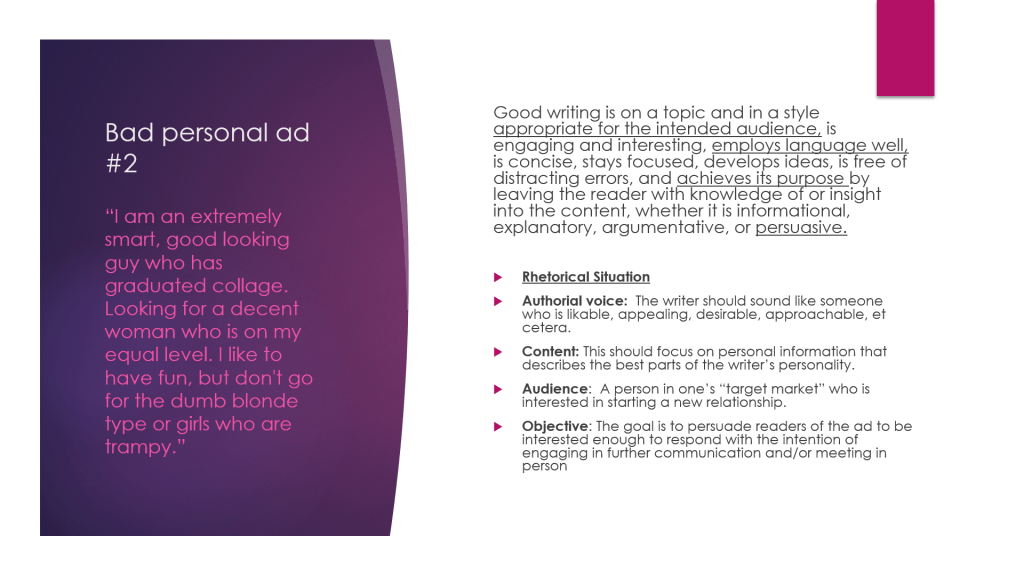
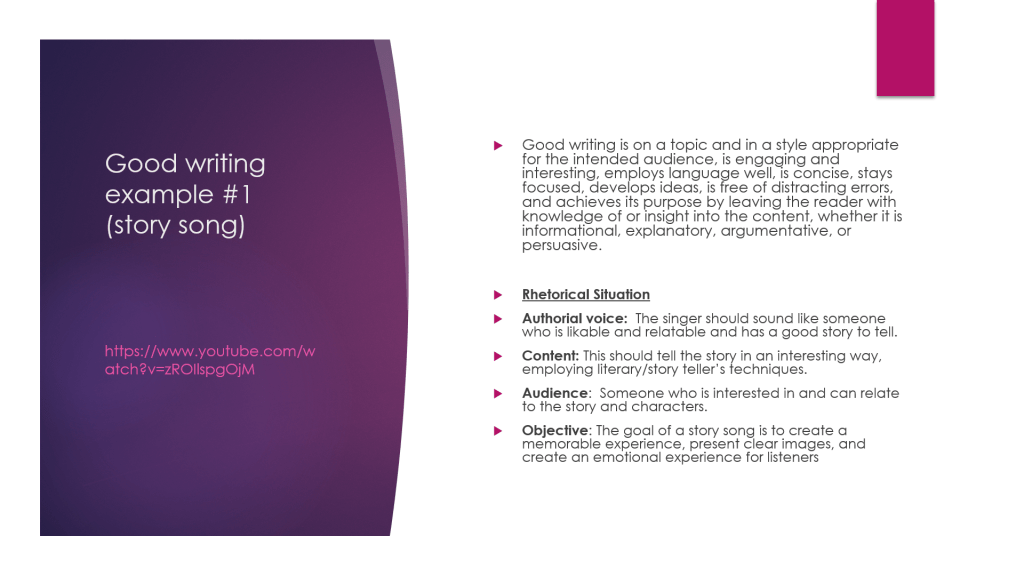
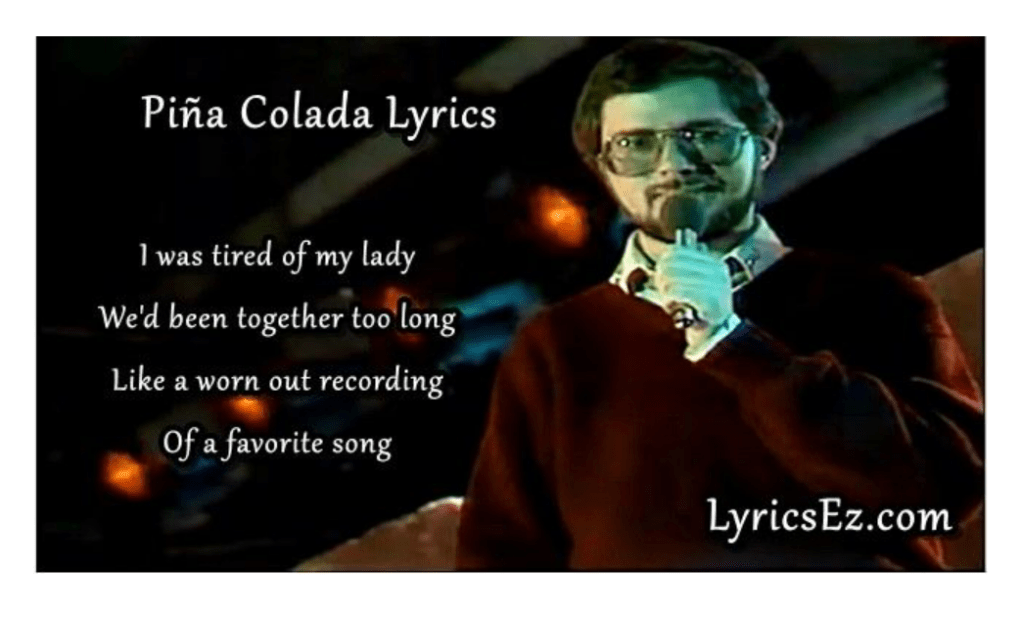
After this, I presented a PowerPoint (some slides below) with our final definition of “good writing.” I also included examples of good and bad writing (introducing another exercise I’ll have them complete over the course of the semester, which is finding good example of good or bad writing and submitting them along with brief explanations of why they are “good” or not. These examples can be from anywhere and to model this I show them four examples of poorly written personal ads and then one example of good writing–a video of Rupert Holmes singing “Escape: The Pina Colada Song. ” I telling them we should all aspire to write something as great as this song someday. It’s a great way to end class 🙂

Day 4:
We begin this class by reading and having a brief discussion on paragraph one of our first reading for the semester (“Self-Reliance”). We discuss some of the points Emerson makes and discuss the style, and I give them some tips for reading the whole essay and writing their summary (a draft of this is due Tuesday) (for this blog, I plan to add the Assignment sheets for the weeks assignments are due, though of course students get them in advance). Then we move on to Exercise 4, which is….
Exercise 4: Quotation, paraphrase, and thesis statements
- Present a direct quote from paragraph 1 of “Self-Reliance.” Do this in three parts: introduce the quote (be sure to identify the author in a signal phrase), present the quote (and page #), then respond to/explain the quote.
- Paraphrase (restate in your own words) the following passage from page 2 of “Self-Reliance”:
“There is a time in every man’s education when he arrives at the conviction that envy is ignorance; that imitation is suicide; that he must take himself for better, for worse, as his portion; that though the wide universe is full of good, no kernel of nourishing corn can come to him but through his toil bestowed on that plot of ground which is given to him to till.”
- Write a thesis statement (see attached handout on Thesis Statements) in response to one of the questions below. In your thesis statement, first present the counterargument, then provide at least 3 reasons supporting your position:
For example, a thesis statement in response to the question: Should a writing class be required for all first-year college students? may be:
While some may argue that college students get enough writing practice in their other classes, a writing class should be required for all students because it will help them develop an efficient writing process, they will learn the value of revision, and let’s face it, students have loads of fun in these classes.
Which sport is the toughest to compete in? Why?
Is it better to have loved and lost, or never loved at all? Why?
Should people be allowed to keep pit bulls as pets? Why/why not?
Should motorcycle riders be required to wear helmets? Why/why not?
Should college students be Facebook friends with their parents? Why/why not?
Should grade-school children have daily homework?
Here’s the handout on Thesis Statements
ENG 104 Thesis Statements
A thesis statement:
- States your argument (your position on a topic + your reasons)
- Serves as a “road map” for the paper; previewing the organization of your essay
- Directly answers the question asked of you (even if you’re not given a question, think of your thesis as an answer to a question).
- Makes a claim that others might dispute.
- is 1-2 sentences long and is presented at the end of the introduction (your first paragraph)
How do you get a thesis?
A thesis is the result of a lengthy thinking process. Formulating a thesis is not the first thing you do after reading an essay assignment. Before you develop an argument on any topic, you have to think about the topic, write about the topic, collect and organize evidence, look for possible relationships between known facts (such as surprising contrasts or similarities), and think about the significance of these relationships. Once you do this, you will probably have a “working thesis,” a basic or main idea, an argument that you think you can support with evidence but it will become more developed throughout the writing process.
How do you know if your thesis is strong?
When reviewing your first draft and its working thesis, ask yourself the following:
- Do I answer the question?
- Have I taken a position that others might challenge or oppose? If your thesis simply states facts that no one would disagree with, you are not making an argument.
- Is my thesis statement specific enough? If your thesis contains vague words like “good” or “successful,” be more specific: why is something “good”; what makes something “successful”?
- Does my thesis pass the “So what?” test? If a reader’s first response is, “So what?” then you need to clarify, connect to a larger issue, or lead the reader to care about your position in some other way.
- Does my thesis pass the “how” and “why?” tests? If a reader’s first response is “how?” or “why?” your thesis is too open-ended.
(handout adapted from: https://writingcenter.unc.edu/tips-and-tools/thesis-statements/)
This is a good in-class group exercise to help prepare students for the assignment due the next class session. It will minimize the number of quotation and paraphrasing errors (and make it easier for me to make comments on these when reading/grading papers) (and because I am using the text for the first reading for this exercise, it helps them understand some of the key ideas they’ll write about in the upcoming assignment). The thesis statement exercise is also valuable in helping them see how to write a thesis/organize an argument.
As far as the process during class goes, I explain the 3 tasks groups have to complete (showing the worksheet on the projector), then tell students who is in each group (3 or 4 students in each, ideally arranged facing each other), then tell them to get together and choose one of the questions for the thesis statements (keeping track so there are no repeats). After they have a designated question, I’ll hand out the worksheet, then give groups a few minutes to being working on these, then move around the class checking progress and making suggestions for changes, making sure by the end of the class that each group has correctly presented a quote and paraphrase and written a good thesis statement. If there is time, at the end of class, I’ll have students write the thesis statements on the board and/or read them aloud, making comments as is necessary to help them all see what makes a good thesis statement.
At the end of class, I showed them a short video. This time it was Brian Johnson’s “Philosopher’s Notes” This guy is such a big fan of Emerson he named his son Emerson and he gives a good overview of some key ideas from the essay. I also gave students links to other videos. I make it clear that they should not repeat anything from the videos in their summaries but I have found that watching these can help students who feel lost in the language and ideas to get some sense of what Emerson is saying (especially students whose first language is not English).
As promised, here is the Assignment Sheet for Assignment 1 (Photo Essay)
So that’s Week 2:
Effort Level: 7/10: Classes are fun and easy but I’m also grading papers (Assignment 1) this week, which (no way around it) takes time and effort.
Enthusiasm Level: 9/10: I’m starting to get to know my students better, we’re having some shared experiences (among other activities, there’s no denying that listening to and watching a video of “The Pina Colada Song” in a dim room brings people together). I’m also getting excited about their experiences reading “Self-Reliance.”
If you to read more about my teaching, check out my other blog posts or my new book Teaching The Way: Using the Principles of The Art of War to Teach Composition: https://amzn.to/3mwbz3y
 Teaching The Way