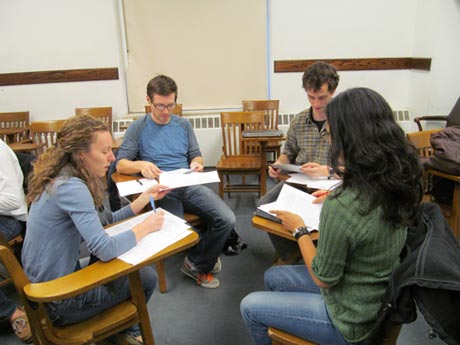
In last week’s post I gave an overview of our first three assignments for the semester and Assignment Sheet 1 (Instructions). I have scheduled the first weeks of the semester with a rough draft of an assignment due Tuesday, peer review in class that day, and the assignment due for a grade on Thursday. In this post, I’m going to talk about the peer review process I use in my classes.
I’ve made my mistakes along the way, but I think the process I use now is working, and this was evidenced most recently by the assignments turned in last week—all papers submitted for grading were markedly improved from those students brought to class for peer review—better organized, more developed, more clearly written, et cetera, and this was all the result of productive peer review sessions.
So, if you want to utilize peer review in your writing classes effectively, I suggest the following:
Before you begin the first time, explain the benefits of peer review. I tell my students there are many, including: 1) getting feedback on one’s draft, 2) learning how to read more critically to see the strengths and weaknesses of a draft, 3) learning how to come up with solutions to problems on a draft, and 4) gaining a better understanding of the requirements for the assignment.
Also, before you begin the first time, go over some guidelines and advice on how to make process productive. Here are the guidelines I give my students:
Guidelines for peer review
- Before you read the paper, read over the peer review sheet so you understand the questions you will be responding to.
- Before you make any comments, read the entire paper.
- If you are working in a group, discuss each question/subtopic on the peer review sheet before you write out your responses.
- When you respond, write in complete sentences so your feedback is clear to the writer.
- Keep in mind your goal is to share your responses (as a reader) to the paper and offer suggestions for revision, but it is not to “grade” or revise the paper.
- Remember to point out the strengths as well as the weaknesses.
- Keep in mind that you are reviewing a rough draft and your classmate is engaged in the peer review process to gain insight into how well his or her current draft is/is not meeting the goals for the assignment and respond accordingly.
- All comments should be constructive, respectful, and considerate of the writer’s feelings.
- Be sure that your comments are clear and focus on the text in the draft, not the writer.
- Be as specific as possible with your responses so the writer will know what you are referring to. Responding with feedback such as “unclear” or “vague” is too general to be valuable. If something is not working, explain why. Likewise, if something in the paper does impress or captivate you, instead of just saying so, explain why it is working well.
- When possible, raise questions and/or suggest new, related subtopics that may have not occurred to the writer.
- Do not attempt to revise any grammatical or stylistic errors. You can point out issues and/or unclear sentences, but do not “rewrite” the paper (that is the writer’s responsibility).
- While you should give valuable feedback/constructive criticism, do not overwhelm the writer with too much. Focus mainly on filling out the peer review form and answering the questions raised there.
- Be aware of your opinions and/or biases and do not let them affect the feedback you give your classmates. While you may not agree with the writer’s argument or stance on the issue being discussed, you can still provide valuable responses about how well the paper is meeting the assignment objectives.
- Keep in mind that while the objective of a peer review session is to provide feedback to a fellow writer, an important benefit of taking this process seriously is that it will help you as a writer—first, as a way to better understand the objectives of the current assignment and secondly, as a way to help you develop the skills you need to revise your own writing in the future.
- When in doubt at any time throughout this process, remember to follow the Golden Rule of Peer Review: treat your classmate’s papers as you want yours to be treated and give the type of feedback you would like to receive.
- As always, if you have questions, ask me for clarification.
The process I’ve found works best goes like this: students come to class with 4 copies of a rough draft (leading up to this, we have discussed the assignment, read sample papers, maybe done prewriting, such as developing a thesis statement if the assignment requires it, thing like that). I tell them to not put their names on the paper, but include a title.
I collect all drafts and spread them out on a spare desk. I go over the peer review sheet in detail, reading and explaining the questions and directing them how to answer them. I break the students into groups (3 is the ideal number) then distribute the drafts to the groups and they get to work.
The Peer Review Sheet for the Instructions assignment is fairly simple but that’s because the assignment is as well. And because I use a very similar sheet as my rubric for grading the papers, one of my goals with this document is to make it perfectly clear to them what the assignment objectives are (it should already be clear on the Assignment Sheet but the peer review sheet frames things differently and sometimes these assignment objectives only become clear to the students after engaging in peer review).
As part of our revision of the composition class two years ago, we created a “universal” rubric we felt could be used for each (and any) writing assignment and I used that pretty faithfully the first semester of teaching this version of the course. But over time I’ve taken the core principles of that rubric and adapted them to each assignment as I found that helps make the goals/requirement of the assignment more clear to students and has led to better papers and a less stressful writing process for them.
So, here’s the Peer Review Sheet I used for the Instructions this semester:
Peer Review for “How Do I?” (Instructions)
Content: Does the writer provide clear, detailed instructions that show readers how to perform the task described?
Controlling Idea: Does the paper stay focused on providing instructions? Are all details relevant?
Author’s Credibility: Do you trust/believe the writer is an “expert” at this topic and that his or her instructions are complete and accurate? Why or why not?
Audience Awareness: Has the writer explained everything in sufficient detail? If not, what questions do you have?
Organization: Is the paper well organized? Are the steps of this process described in the correct order?
Language Use: How well does the paper use language to clearly how to do this task? Are all sentences clear? Is there variety in word use and sentence structure to keep you engaged as a reader?
Other comments and/or suggestions for revision:
Some of these are Yes/No questions, which I found could be problematic in that they could be answered in a single word, so I require students to explain their answers with two or three complete sentences that refer specifically to the content of the paper being reviewed. I tell my students they are not allowed to repeat any of the language from the questions in their answers. I learned this the hard way, with too many students responding with comments like:
This paper uses language well, the sentences are clear, and there is variety in word use and sentence structure. Great job!
Even if this is true, without explaining why it is true, this is not helpful to either the writer or the reviewers. I tell my students someone there should be enough specific details in their answers to the questions so someone who reads only the peer review sheet should know what the paper focuses on. This is something some students are able to do right away, but others need time and practice to get good at it.
For peer review, I don’t put students in groups with their own drafts. There are two reasons for this—first, while there is a benefit to being privy to the group’s critiques, I don’t think first year composition students are ready for this. For the writer (remember, many of them are anxious about their writing, and themselves), the 20-25 minutes having classmates read their draft and discuss its merits will probably be the worst, most uncomfortable, anxiety-producing minutes of the day, if not the entire semester. Equally important, the other group members will not engage in the kind of frank, in-depth critiques they need to if the writer is sitting right beside them. Ideally, students’ drafts are on the other side of the room because I know when some students hear their classmates discussing their paper, they will get distracted from the paper in front of them, the one they should be focused on.
As the groups are engaged in peer review (first the quiet reading of the papers then the hopefully energetic conversations as they work on filling out the peer review sheets) I will also have a copy of every draft being reviewed and typically have time to read over the first page and peruse the rest while the groups are working. I will also go around and ask if they have questions, answering them if I can, and repeating to the class as needed.
When a group is finished, or think they are, I go to them and look over the peer review sheet to make sure they have answered all questions clearly, in sufficient detail, and in complete sentences. If they have responded incorrectly or not gone far enough explaining their responses, or have been too nice or too critical, I direct them how to make changes. The feedback they give will not be perfect, but I want to be sure that when the writer gets the peer review sheet back, there is some usable, valuable feedback.
Once the peer review sheet has been filled out to my satisfaction, I collect it along with the papers (which they are also required to write feedback on) and then give the group another set of drafts and a clean peer review sheet. I never give any of the drafts or completed peer review sheets back to the students until all papers have been reviewed so they understand there are no rewards for trying to hurry through the process.
So this is how I do it in my classes. Now on to the benefits.
The one the students may be most interested in the first time they do peer review is the practical one of getting feedback on their writing, suggestions they can use as a guide for revision before turning a paper in for a grade. This is undeniably valuable and as I said earlier, this semester all their first assignments submitted for grading were markedly improved from the rough drafts.
But sometimes the first time through, students don’t give (or consequently get) great feedback. This is because they’re just starting to wrap their heads around the process, may not yet know exactly how to achieve the goals of the assignment, and may focus too much on some tired, old rules left over from their previous English classes. So, in a way, I use the first round of peer review to help teach them how to do peer review. They’ll do better the second time through, and better than that the third. So their first experience with peer review is kind of like a rough draft, full of mistakes, but it is time well spent because that’s how they learn.
But even if students don’t get great feedback, they should be able to better see what the goals of the assignment are and revise their own papers accordingly, with the knowledge they gained from reading and responding to their classmates’ papers.
The biggest benefit of peer review is the development of the skills needed to read a draft: to see the strengths and weaknesses, how well it is meeting the objectives of the assignment, and then be able to give clear, practical advice on how to revise the paper. The key for their futures as writers is to get them able to read their own papers like readers, see the strengths and weaknesses of their own drafts. Peer review helps them learn how to do this.
Before I conclude, there are a few more keys to make sure the time spend doing peer review is productive.
First, it is important to model the kind of critique you want them to engage in. So the day before a peer review session, my classes always do a full-class peer review with a paper from a previous semester. Everyone gets the same paper, we read it aloud one paragraph at a time, I either give them the Peer Review sheet or write a series of similar questions on the board, break them into groups for ten minutes of discussing and answering the questions, then we’ll discuss it as a class, starting with their responses and with me only chiming in if they are off-track in their responses. For this exercise, I have found that students can learn just as much looking at a bad draft as good ones so I often bring one of each to these peer-review norming sessions. Seeing both successful and unsuccessful drafts (and discussing why they are) before this draft is due is very valuable in better helping them understand how to write their own papers.
Another important part of the process is that after all the drafts have been reviewed, before I hand them back to the students, having been paying attention to the drafts and the feedback, and jotting down notes to myself along the way, I take some time to go over any recurring errors I have noticed: whether it be citation errors, a misunderstanding of assignment objectives, grammar problems, whatever I think is important for all of them to think about before they start to revise.
If I have time, I will write passages from drafts, good or bad, on the board for quick discussions. Sometime after I hand back their drafts, I give them all a revision or writing related task to complete. Some examples of these are:
What was the most valuable feedback you received from your classmates?
What is the one change you plan to make when you revise this paper?
What did you see, either good or bad, in a classmate’s paper that has helped you better understand how to revise your own paper?
Even if I don’t ask them to do anything, I like to hand back the drafts and peer review sheets with at least a few minutes left in class. I ask them to look things over and ask questions before they leave for the day. I remind them that it is an imperfect process and that the feedback they are getting is just that: feedback. It doesn’t mean they have to do everything suggested. But I tell them reading over the feedback carefully is an important part of their revision process, and, as always, to let me know if they have any questions.
I’ve heard some teachers (and students) say that doing peer review is “amateur hour” that produces no good feedback and that putting students in groups is taking the “easy way” out. They say the latter as a criticism, but I kind of agree. Because putting students in groups for peer review can be an “easy way” to make the assignment objectives clear to them, putting them in a better position to learn and meet their goals, and it makes my job grading the papers much easier.
As far as it being “amateur hour,” it may start that way, but part of my job is to teach my students how to make it a very productive hour. If my students were not engaged in peer review and not giving each other valuable feedback, it would be my fault.
It’s also important to remember that just because something is harder for the teacher, it does not mean it is better for the students. One of the things I like about peer review is that my students are working hard (and learning) and I’m not. I can kind of coast through these days, storing up my energy for grading (which is hard work—and I’ll talk about that next week).
If you want to read more, come back for more and/or check out my book: Teaching The Way: Using the Principles of The Art of War to Teach Composition.
Here’s a link: https://amzn.to/3mwbz3y
Thanks for reading!
 Teaching The Way